
I have driven past a hundred signboards for weekend getaways since moving to Dehradun. Most of them lead to the same places—the same Mussoorie crowds, the same Rishikesh cafes with fairy lights, the same campsites where tents are pitched two feet apart. So when someone told me about camping near Dehradun at a place called Itharna Temple, I was genuinely expecting little. A year of living here and I had never heard the name.
That was my mistake. And I am glad I made it.
The Road That Tests You First
We left at 8:30 in the morning. The plan was 8. So already, a positive sign. Some of my best days have started late.
The first stretch from Dehradun toward Rishikesh is a clean highway, easy driving, the kind of road where you roll down the windows and stop thinking about whatever you left behind at home. Sometime later, the mountains start filling the windshield. The city doesn’t disappear so much as it just… stops mattering.
But after you turn off the main highway toward Itharna village, the road changes. And I mean that in the least poetic way possible. It physically changes. Landslides had come through recently. Big ones. Boulders the size of small cars sitting in the middle of the road. Our vehicle crawled over patches that felt like driving on a riverbed. I remember gripping the door handle and telling myself this was fine.
It is fine. It just requires patience and a car with decent clearance.
Here is what I didn’t know then: the road is testing you. Not in some spiritual metaphor way. Just, if you are not willing to drive carefully through thirty minutes of rough mountain road, you will turn back. And because most people turn back, what waits on the other side stays exactly as it is. Empty. Quiet. Untouched.
What Waited on the Other Side
I don’t have a clean way to describe the moment we arrived at the tableland. I will just tell you what I saw.
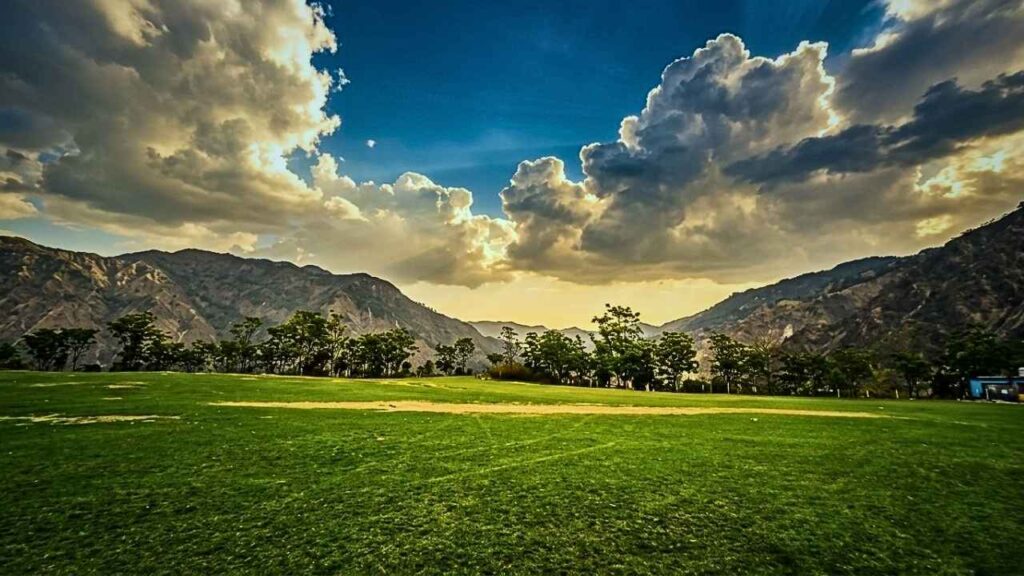
A flat plateau, completely open, covered in deep green grass. Mountains on three sides. Not distant soft mountains, but close, present, and surrounding. On the fourth side, a temple complex, old stone, and quiet. The sky above was doing something dramatic with clouds. There was nobody there.
I got out of the car and said something out loud to nobody in particular. I don’t remember what it was. Something embarrassing, probably.
This is what camping near Dehradun can actually look like, and I had spent a year not knowing this existed. That felt like a waste. I am telling you about it now so you don’t make the same mistake.
The Temple Before Anything Else
We didn’t set up camp first. That felt wrong.
Itharna Temple is old in the way that Uttarakhand temples tend to be old. No signs explaining its history, no ticket counter, no crowd management. Just the smell of incense from somewhere inside, a small bell, and stone worn smooth from years of hands. We went in, spent some time, and came out.
I am not going to tell you it was a spiritual experience. Maybe it was, maybe it wasn’t—that depends on what you bring to a place like that. What I can tell you is that it was quiet in a specific way. The kind of quiet where you hear your own breathing. Where a conversation feels unnecessary. Where you realize you have been carrying a lot of noise around inside you that you didn’t notice until it stopped.
We came out and stood in the sun for a while without saying much.
Three Trees and a Kitchen
The tableland was mostly open, and the sun that day was working hard. We walked the lawn looking for shade. And then there were three trees, perfectly spaced, offering a triangle of cool shadow and a breeze you could actually feel. Everyone in the group moved toward them at the same time, like a coordinated decision nobody made out loud.
This was our camp. No tent. No complicated setup. Just a tarpaulin spread on the grass, cooking equipment out of the boot of the car, and a portable gas stove that had seen better days but never let us down.
The menu was not the menu of people roughing it. Dal Makhani. Paneer Tikka Masala. Laccha Paratha. Boondi Raita. Quinoa, because someone in the group is always on something.
I want to say something about cooking outside that I don’t think I can fully explain. The same recipe you’ve made in your kitchen a hundred times tastes different under the open sky. The dal takes longer, but it tastes slower too, if that makes any sense. The Paneer Tikka Masala sends its smell in all directions and suddenly feels like an event rather than a meal. We cooked slowly, talked while cooking, argued about whether the gas flame was the right height, and ate on the grass with mountains watching.
Nobody looked at their phone during the meal. Not because we agreed to some rule about it, but just because nobody thought of it.
The Nap That Fixed Something
After we ate, we washed the dishes at a tap near the temple complex, came back to the three trees, and lay down.
I fell asleep for maybe forty minutes. I don’t know exactly. What I know is that when I woke up, the quality of the light had shifted slightly golden, the breeze had picked up a little, and I felt—there is no better word for this—restored. Not rested. Restored. Like something had been quietly put back in place.
I have slept in five-star hotel rooms with blackout curtains and temperature control. I have taken business-class flights where the seat becomes a flat bed. None of it has ever done what those forty minutes under three trees at Itharna did.
Maybe it’s the altitude. Maybe it’s the silence. Maybe it’s just what happens when you stop moving for long enough in a place that doesn’t want anything from you.
Lemon Tea at the Edge of the Afternoon
My daughter made lemon tea. Freshly squeezed, hot, in cups. There was cake, the kind from a bakery box that’s slightly dry but somehow perfect with tea. And cookies.
We sat in the shade and talked the way people talk when there is no particular destination to the conversation. Old stories came up. Someone said something that made everyone laugh for longer than it probably deserved. The afternoon stretched.
This is the part that is hardest to recreate in a blog post, the specific texture of a good afternoon in the middle of nowhere with people you like. I can tell you what we ate and drank and where we were sitting. I cannot fully transfer what it felt like to have nowhere to be, nothing to do next, and a cup of warm tea in the mountains.
You have to go and find your own version of it.
The Last Walk
Before we packed up, we took one more loop around the tableland. No cameras this time. Just walking.
I kept thinking about something I have thought about a lot since leaving corporate life: how much of what we call busyness is just habit. The habit of filling time. The habit of forward motion. The assumption that productivity is the point.
Standing at the edge of that plateau with mountains on three sides and the temple behind me, I wasn’t producing anything. I wasn’t building anything. I wasn’t networking or optimizing or scaling anything.
I was just there. And it was, without question, enough.
That is what I mean when I say, ‘Life is an Endless Vacation.’ Not that you need to quit your job or move to the mountains or buy expensive gear. Just that moments like this one, where a tableland, three trees, dal makhani, and lemon tea are available to you, more often than you think. Camping near Dehradun doesn’t require a week off or a big budget. It required one free morning, one willing group of people, and the willingness to drive through thirty minutes of rough road.
We packed up, loaded the car, and drove back as the light went golden. The landslide road felt easier on the return. It always does when you know what’s behind you.
What to Carry If You Go Camping near Dehradun
Since you’ve come this far in the post, here are the practical notes, short and specific.
For food and cooking: a portable gas stove, one cylinder, and steel cookware. Carry all ingredients prepped and pre-measured if possible. It saves time and reduces waste. For a group of six, we found one full meal comfortable to cook on a single stove.
Camping setup: Tarpaulin or picnic mat, enough for your group to sit and lie down. Shade is available under the trees we found, but it’s not guaranteed in peak summer. So carry a pop-up shade canopy if you’re going April to June.
Water: Carry more than you think you need. There is a tap near the temple, but don’t rely on it as your primary supply.
A note on the waste: Carry it all back. Plastic bags, food scraps, and everything that you carry there, you must carry it back too. The site doesn’t have any waste management. The reason it’s still beautiful is because people have left it that way.
Timing: October to March is ideal. The grass is greenest after the monsoon, which is September to November, if you can handle the occasional cloudy day. Avoid peak summer weekends. Not because it gets crowded, but because the sun is genuinely harsh on an open plateau. Check conditions before you go.
Getting There
Route: Dehradun → Rishikesh Highway → turn toward Itharna Village → follow the road to the temple complex.
Distance: Itharna temple is approximately 45 km from Dehradun.
Drive time is around 2 hours depending on road conditions. The final stretch from Itharna Village to the temple is rough, so go slow. Use a vehicle with decent ground clearance.
Best time to start: No later than 8:30 AM if you want a full day at the site.
Permissions: no entry fee and no permits required as of my visit. Respect the temple premises and the surrounding land.
Navigation: Search “Itharna Temple” on Google Maps. It’s on the map. The road condition Google shows won’t reflect reality. That final stretch is rougher than it looks on the app.
Read more on Uttarakhand Tourism.
If you go, I would genuinely love to know what you find there. The three trees might be in a slightly different spot. The light will definitely be different. But the tableland, the mountains, and the quiet, those will be the same.
Some places hold.
Amit Chilka is the founder of Life is an Endless Vacation. He left 22 years of corporate life to travel slow, live in Dehradun, and prove that the best meetings happen around a campfire. For Campfire Convos and speaking enquiries: amit@lifeisanendlessvacation.com