
Let me tell you something nobody warned me about before our first camping trip. We had the destination sorted—Hadshi Lake, an hour from Pune, backed by the iconic Tikona Fort. We had the enthusiasm. What we didn’t have was the right camping gear India actually demands—the right tent for the wind, enough warm layers for the sudden night chill, and a kitchen setup that could handle a proper meal outdoors. We figured it out eventually. But you don’t have to learn the hard way. This checklist is everything we wished we’d had before we left.
Why Camping Gear India Needs Its Own Checklist
Most camping gear guides you find online are written for Europe or North America. They assume a single climate, standard trail conditions, and gear that’s available in REI or Decathlon US. India is a completely different story.
One weekend you could be camping at a breezy lakeside in Maharashtra, where the temperature drops sharply after midnight. The next, you’re at a high-altitude site in Ladakh, where even summer nights dip below zero. Then there’s the Western Ghats during monsoon, where waterproofing everything you own is not optional—it’s survival.
The camping equipment market in India was valued at USD 892 million in 2024 and is projected to hit USD 2,027 million by 2030, growing at a CAGR of 14.66%. Millions of Indians are heading outdoors for the first time, and most of them are making the same gear mistakes. This checklist fixes that before you even leave the driveway.
The Tent: Get This Right First
Your tent is the single most important item on any camping gear India list. Everything else is negotiable. This is not.
A beginner’s biggest mistake is either buying a tent that’s too small (miserable when two people actually try to sleep in it) or too large (a nightmare to pitch solo, especially in wind—ask me how I know). Here’s a simple guide:
| Campers | Recommended Tent Size | Decathlon Option | Price Range |
| Solo | 1–2 person dome | Quechua MH100 2P | ₹2,499 – ₹4,599 |
| Couple | 2–3 person dome | Quechua MH100 3P | ₹3,599 – ₹5,599 |
| Family / Group | 4–6 person with bedroom | Quechua MH100 4P | ₹5,999 – ₹11,999 |
| Absolute beginner | Pop-up instant tent | Quechua 2 Seconds Easy | ₹8,999 |
One non-negotiable tip: Practice pitching your tent at home before the trip. We spent 45 embarrassing minutes wrestling a 6-person tent in a Hadshi Lake breeze because we’d never opened the bag before. Your first pitch should not be in the wind at 4 pm with two families watching.
Sleep Setup—Comfort Makes or Breaks the Trip
A bad night in a tent doesn’t just ruin the night—it ruins the entire next day. Your sleep setup is your second most critical camping gear India investment.
- Inflatable sleeping mattress: non-negotiable. Sleeping directly on the ground is cold, uncomfortable, and honestly unnecessary when good options start at ₹1,500 at Decathlon. Self-inflating models are the easiest to use.
- Sleeping bag: Match the temperature rating to your destination. Maharashtra and the Western Ghats in winter need a comfort rating of 5–10°C. The Himalayas or Ladakh demand -5°C or lower. Don’t guess—check the forecast.
- Sleeping bag liner: A thin fleece liner adds 3–5°C of warmth and keeps your sleeping bag cleaner for longer. It costs under ₹800 and weighs almost nothing.
- Inflatable camping pillow: Packs to the size of your fist. Your neck will write you a thank-you note.
Kitchen Setup: Because Outdoor Food Is the Best Food
Here’s the truth about camping food that nobody puts in gear guides: cooking outdoors is one of the best parts of the whole experience.
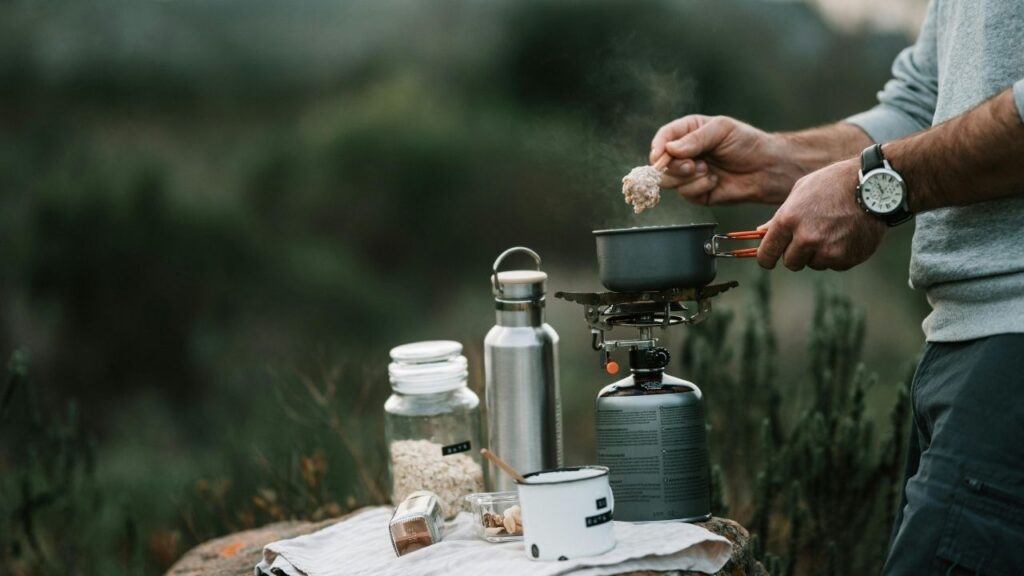
We made aloo puri, shrikhand, pulav, and a full mix pakoda spread—paneer, aloo, pyaaz, and mirchi—on a single butane gas stove at Hadshi Lake. It was one of the most satisfying meals of my life. The right camping gear and India kitchen setup makes this possible.
- Butane gas stove: compact, reliable, and easy to use. Decathlon’s Forclaz stoves start around ₹1,200. Always carry at least two gas canisters—one will run out faster than you expect.
- Folding cooking table: Keeps your kitchen off the ground. Makes cooking dramatically more comfortable. ₹800–₹1,500 on Amazon or Decathlon.
- Stainless steel mess kit: Pot, pan, plates, bowls, and cutlery in one compact set. Decathlon’s Quechua camping cooksets are a solid value.
- Folding chairs and stools: Get the ones low enough to sit at the water’s edge. Sipping chai with your feet in a lake from a folding stool is a moment you’ll remember for years.
- Cutting board and foldable knife: Small, light, essential.
- Ziplock bags and airtight containers: For ingredient storage and keeping food safe from insects and wildlife overnight.
- Collapsible silicone wash basin: For doing dishes. Weighs almost nothing, folds completely flat.
Lighting and Power: Don’t Get Caught in the Dark
This is one of the most underestimated categories in any camping gear India checklist.
- Headlamp: Both hands free at night is not a luxury, it’s a necessity. Petzl Tikkina and Decathlon’s Caperlan range are reliable and affordable. Always carry spare batteries.
- Camping lantern: A solar or battery-powered lantern transforms the inside of your tent into something warm and cozy. Also creates brilliant campsite ambience.
- High-capacity power bank (20,000 mAh minimum): There are no plug points in the wild. Charge everything before you leave and keep the power bank topped up.
- Solar charger: Optional for a 2-night trip, essential for anything longer.
Clothing: Layer More Than You Think You Need
India’s camping nights are famously deceptive. Sunny and warm at 5 pm, surprisingly cold by midnight. We experienced this firsthand at Hadshi—the temperature dropped fast once the sun was gone, and we were not fully prepared.
The golden rule for camping gear India clothing is: layer, don’t bulk. Three thin layers beat one heavy jacket every time.
- Thermal base layer: One set for a 2-night trip. Decathlon’s Wedze thermals are affordable and do the job well.
- Fleece mid-layer: Light, packable, and surprisingly warm. The workhorse of camping warmth.
- Windproof or waterproof outer jacket: Even without rain in the forecast, wind chill near lakes and in hill stations is real and biting.
- Quick-dry t-shirts and pants: Avoid cotton for camping. It absorbs sweat, stays wet for hours, and gets cold fast. Synthetic or merino dries quickly and stays fresher longer.
- Warm socks: two extra pairs minimum—cold feet at 3 am are genuinely miserable. Pack more socks than you think necessary.
- Ankle-support trekking shoes: Essential for uneven ground. Decathlon’s Quechua NH100 mid shoes start around ₹2,999 and are excellent value for beginners.
- Flip-flops: For around the campsite and at the water’s edge. Your trekking shoes will last longer if they get a rest.
Hygiene and Health: The Unglamorous Essentials
Nobody writes enthusiastically about this section, but ignoring it ruins trips. Here’s what belongs in every camping gear India kit:
- Biodegradable soap and shampoo: Especially important near lakes and rivers. Regular soap harms aquatic ecosystems. Brands like Biotique and Khadi have good options.
- Microfibre towel: Dries in minutes, rolls up to the size of a water bottle.
- Wet wipes: Lifesavers when water access is limited. Pack more than you think you need.
- Hand sanitiser: Before every meal, no exceptions.
- Toilet paper and a small towel: Follow leave-no-trace principles: dig a small cat hole at least 60 metres from any water source, bury waste, and pack out used paper.
- Insect repellent: Odomos cream or Jungle Formula spray. Especially critical for monsoon camping or forested areas.
- Sunscreen SPF 50+: UV intensity at altitude and near water is high even on overcast days.
- First aid kit: Plasters, antiseptic cream, ORS sachets, pain relief tablets, antihistamines, personal medications, and Diamox (altitude sickness) if you’re heading above 3,000 metres.
The Bag: What to Carry It All In
Your choice of bag depends entirely on how you’re getting to the campsite.
- Backpack (40–60L): Essential if you’re hiking in. Decathlon’s Forclaz MT100 is a great beginner option at around ₹2,999. Look for padded hip belts — they transfer weight off your shoulders significantly.
- Duffel bag or large tote: If you’re driving to the campsite, a duffel is actually easier to load and unload than a rigid backpack frame. We used this approach at Hadshi and it worked perfectly.
- Dry bags: Waterproof your electronics, spare clothes, and documents inside whatever bag you carry. Absolutely essential during monsoon camping in the Ghats.
The Small Things That Save the Day
These are the items that don’t make any Instagram camping flat lay but will matter more than you expect once you’re actually out there:
- Duct tape (small roll): Fixes tent poles, torn fabric, broken shoe soles. Just carry it.
- Multi-tool or Swiss Army knife: More useful situations than you’d believe.
- Paracord or rope (10–15 metres): Clothesline, tent guy rope backup, securing gear in the car. Always earns its weight.
- Garbage bags: Pack out everything you pack in. No exceptions, ever.
- Matches AND a lighter: Both. Because one will fail at the worst possible moment.
- Offline maps downloaded: Google Maps loses signal in the hills. Download Maps.me or OsmAnd before you leave home.
- Emergency whistle: Costs ₹50. Could matter enormously.
Camping Gear India: What Will This Cost You?
The good news about building your camping gear India kit is that most of it is a one-time investment. Once you have the tent, sleeping setup, and kitchen gear, your per-trip cost drops dramatically.
| Category | Budget | Mid-Range |
| Tent (3–4 person) | ₹3,600 | ₹12,000 |
| Sleeping bags (per person) | ₹1,200 | ₹3,500 |
| Mattresses (per person) | ₹900 | ₹2,500 |
| Cooking setup | ₹2,000 | ₹4,500 |
| Clothing and footwear | ₹3,000 | ₹8,000 |
| Lighting and power | ₹1,500 | ₹3,500 |
| Hygiene and first aid | ₹800 | ₹1,500 |
| Total (approx.) | ₹13,000 | ₹35,500 |
Decathlon India is your best single destination for camping gear shopping in India—quality, availability, and price point all work in your favor across almost every category.
Camping Gear India: One Last Thing Before You Go
The best camping gear India trip I’ve had wasn’t the one with the most expensive setup. It was a windy afternoon at Hadshi Lake, where we fought a tent for 45 minutes, cooked pakodas on a single-burner stove, and sat on plastic stools with our feet in the water watching Tikona Fort glow in the early morning light.
You don’t need perfect gear to have a perfect trip. Buy what you can, learn as you go, and just show up. The gear improves with every trip. The memories start on day one.
Life really is an endless vacation—pack the tent and go find yours.
Wanna join me on camping trips? Write to me at amit@lifeisanendlessvacation.com
Explore more on Road Trips, Treks & Food.
FAQs on Camping Gear India
What is the most important camping gear India first-timers should buy?
A good quality tent that suits your group size and destination weather. Everything else can be improvised or upgraded later—a bad tent cannot.
Where can I buy camping gear in India?
Decathlon India is the best one-stop option for beginners—wide range, good quality, and honest pricing. Amazon India and Himmaleh are also solid choices for specific items.
How much does camping gear cost in India for beginners?
A functional starter kit costs around ₹13,000 on a budget, going up to ₹35,000 for mid-range gear. Most items are a one-time investment that pays off across many trips.
Himmaleh — Camping Equipment Checklist — detailed gear deep-dive
Do I need different camping gear for different regions of India?
Yes. Himalayan camping needs high-rated sleeping bags and thermal layers. Desert camping needs light day clothing and warm night layers. Western Ghats camping needs waterproofing. Always match your gear to the region. Also read the India Hikes -Trekking Gear Guide
Is Decathlon good for camping gear in India?
Absolutely. Their Quechua and Forclaz ranges offer excellent quality at accessible price points—perfect for first-time campers building their kit without overspending.