
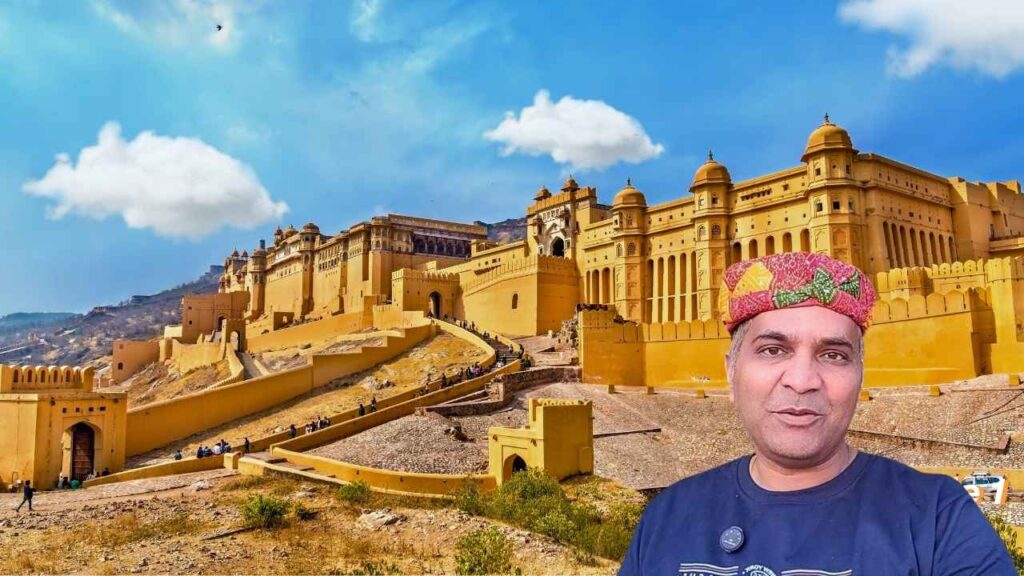
I’m going to tell you a story that I’ve been carrying around with me for weeks now. It’s about a fort I went to in Jaipur. It’s about love, history, and secrets carved into stone. And it’s about how one day changed the way I see everything around me. But before I get into that, I need to be honest: I almost didn’t go to Amer Fort.
I’ve been to a hundred historical sites and a dozen palaces. I’ve done all the touristy things: taken a selfie, checked the guidebook, and that’s it. When someone told me about Amer Fort, I thought I knew what to expect. Another lovely building. Some really cool buildings. Perhaps a nice picture or two. What really happened was not what I thought would happen.
I didn’t think my whole view of the world would change.
The Day I Figured Out I Didn’t Know Anything about Amer Fort
The first time I went through the Suraj Pol, or Sun Gate, of Amer Fort was on a Tuesday morning. The pink sandstone was getting the right amount of sunlight, and to be honest, it looked like every other fort I’d been to. Yes, that’s impressive. But nothing that will change the world.
The guide I hired, a local named Rajesh who, thank God, wasn’t the usual “point and talk” type, began to tell me the history. King Mansingh. 1589. Built while Akbar was king. Brilliant in the military. Blah blah blah. I had heard it all before.
But then he said something that made me stop.
He said, “This fort isn’t just a fort.” “It’s a book. Every wall, every room, every tunnel tells a story. But most people don’t bother to read it.”
At that point, the real tour started.
The Psychology of Control and the Architecture of Power
When tourists go to Amer Fort, they usually see the Diwan-e-Aam (Hall of Public Audience), the Sheesh Mahal (Hall of Mirrors), and maybe the gardens. They snap pictures. They go. And they think they’ve “finished” the fort!
But they don’t get why everything was built the way it was. And once you know the “why,” you can’t forget it. Believe me.
Imagine that you are King Mansingh. You are the military leader for one of the world’s most powerful emperors, Akbar. You are in charge of areas all over India. Furthermore, you have 12 wives. And you need to keep your family safe, stay in charge, and leave a legacy.
How do you go about it?
You make a fort that isn’t just a fort. You put together a machine.
The first thing that struck me was the Jaleb Chowk, which is the first courtyard. This is where regular people came. This is where justice was served. And here’s the smart part: there are three gates in the courtyard.
Suraj Pol (Sun Gate)—the first place the sun shines. Where the king would ride in on his royal elephant. What does it mean? Strength. Light. Power.
Chand Pol (Moon Gate) was the entrance for regular people. Where the moon comes up. What does it mean? They were going in in the dark. They were “lesser.” The buildings themselves were helping to keep the class system in place.
Singh Pol (Lion Gate) protected the entrance to the inner parts. The frescoes on it are still there after 400 years.
Do you understand what’s going on here? The fort is a machine that uses architecture to send power. It’s all psychology dressed up as stone: every gate, every courtyard, and every level.
The Tech at Amer Fort That Made Me Change My Mind
When Rajesh took me to the Hammam, which is a Turkish bath, I really thought he was going to show me how to do some basic plumbing from the Middle Ages. I was wrong.
The system worked like this: wood would burn under two big water tanks. The heat would move through copper plates below, warming the water. The bathing room would get hot water through small copper pipes. And here’s the best part: sandalwood, rose water, and perfumes would be added to the water.
In other words, there was a fancy spa in a war fort 400 years ago.
It’s not just about being rich, though. It’s all about strategy. The king needed to unwind after a long day of planning for the army. The spa wasn’t a treat; it was upkeep. It kept him on his toes. It helped him stay sane.
The old flush toilets were next to the Hammam. Drainage that works with gravity. Sewers that are underground. Engineering that wouldn’t be common in Europe for another 200 years.
And then there was the Sukh Niwas, or Summer Palace, where the air conditioning system was a work of art. You could make a waterfall effect by using marble waterfalls with Jali work that looked like a lattice. The water would make mist as it fell. The mist would naturally cool the whole room. In the 1600s, Jaipur didn’t have electricity or air conditioning, but they had built a palace that stayed cool on its own.
As I stood there looking at this system, I realized something that made my stomach drop: we think we came up with everything. No, we didn’t. We just found it again.
Where It All Gets Dark
But this is when the fort stopped being cool and started to get hard.
The fourth courtyard. The Zenana.
This is where the twelve queens lived. Every queen had the same room. Same courtyard. Windows with the same laticed pattern. Everything was shut down. Everything was locked up. There was no way out.
And when you stand in that courtyard and look at those small, beautiful, identical rooms… Something inside you breaks a little.
Because you know this isn’t a palace. This is a cage made of gold.
Some of these women were princesses in their own right, and they were locked up. They weren’t allowed to go outside. Those windows with the latticework made it hard for them to see the world outside. They couldn’t always breathe fresh air.
Yes, there were lovely gardens. Yes, the Sukh Niwas had air conditioning. And, there were fancy bathing rooms and servants who took care of all their needs. But having money and freedom are not the same thing.
And here’s the thing that really got me: the guards at the end of the Zenana were eunuchs. Why are there eunuchs? Because they couldn’t hurt the women because of how they were built. The king was basically saying, “I trust you to keep my queens safe, but I don’t trust men. I need beings who can’t be a threat because of their biology.”
What does that tell us about how the king sees the world? What does he think about women? And what about his fear?
I stood in that courtyard for a long time, just… thinking.
Amer Fort’s Secret That Made Everything Different
But then Rajesh led me to the Sheesh Mahal marble panel.
He said, “Look at this. This is a flower.”
It was a small flower carved out of white marble. Pretty but not very interesting. “Okay,” I said. “It’s nice.”
He said, “No. You’re not looking at it right. Come here and look at it from this angle.”
The flower looked like a fish’s tail from above.
“Now here.” A 45-degree angle. Now it was a flower.
“Here.” A different angle. A cobra with a hood.
“Here.” A trunk of an elephant.
“Here.” The tail of a lion.
“Here.” Corn.
“Here.” A scorpion.
SEVEN different things. A stone that has been carved. Different points of view.
I stood there looking at this flower, and I felt something in my chest change. Because I understood what the artist was trying to say. What the king told his queen all those years ago.
Reality is not set in stone. Your point of view changes the truth.
In a love chamber, where a king and queen met after battles and wars, the artist said, “You see me one way. I see myself another way. Neither of us is wrong. We’re just looking from different angles.”
That’s more than just philosophy. That’s a master class in how to get along with others.
And it was made out of marble 400 years ago.
Amer Fort’s Tunnel That Talks About Fear
The fort wasn’t just about love and ideas, though. It was also about staying alive.
There is a tunnel that goes straight to Jaigarh Fort that is 2 kilometers long. There are no decorations. It’s not big. It’s only for use. And it exists for one reason: if the fort was attacked, the whole royal family—the queens, the kids, everyone—would use this tunnel to get to safety.
And what about Jaigarh Fort? The Jaivana Cannon. The biggest old cannon in the world. Two hundred fifty tons. Only fired once. The noise was so loud that it broke the soldiers’ eardrums.
Here’s the problem: the same king who built a philosophical marble flower love chamber also made huge cannons and escape tunnels. He was both romantic and smart. Both kind and cruel.
That’s when I figured it out: History isn’t simple. People aren’t good or bad. They’re hard to understand. Not the same. People.
The Garden at Amer Fort That Never Was
The Saffron Garden was the last thing Rajesh showed me. King Mansingh wanted to grow saffron, which is the most expensive spice in the world. He brought saffron plants back from Kashmir. He made the most beautiful garden. And practically, he did everything right.
But the heat in Rajasthan was too much. The saffron couldn’t make it. The garden did not work.
That garden is still there, a reminder of a king’s unfulfilled dream.
As I stood there looking at a garden that didn’t work, I thought about all the times I’ve tried to make things happen. All the times I’ve tried to make things go my way. I’ve learned that there are some things we just can’t change.
And sometimes, the best thing a leader can do is admit that they failed. Don’t touch it. Remember that even kings can’t control everything.
The Epiphany That Altered My Perspective
That night, as the sun was turning everything golden, I walked out of Amer Fort and had a moment of clarity. And I want to share it with you because I think it’s important.
Each of us has our own Amer Fort.
We put up pretty walls around ourselves. We make safe places, systems, and routines. Some of those systems are helpful to us. Some of them catch us. While some are pretty, some are limiting. Some are both at once.
We also make up stories about why we built them. “It’s for protection.” “It’s for love.” “And it’s for safety.” And all of those things could be true. But they could also be partly true. Or it could be true from one point of view and false from another.
The magic flower teaches us that reality changes depending on how you look at it. And you’ll never see the whole truth unless you actively change your point of view and question the walls you’ve built.
The king made a palace. It was a love story. It was lovely. But, it was also limiting. Both things were correct.
We do the same thing. We make careers that are rewarding but tiring. Additionally, we form loving connections that can also hinder our progress. We also make lives that are safe but not very big.
And the question that changed my whole view of the world was this: From which angle are you looking? And have you thought about the possibility that there are other points of view you haven’t looked into yet?
What This Means for You
When you go to a historical site, you’re not really there to see the past. It’s about now. It’s about thinking about the decisions people made hundreds of years ago and asking yourself, “What am I learning? How does this change me?”
The Amer Fort showed me that beauty and being trapped can happen in the same place. That idea can be carved into stone. That one flower can teach you lessons for the rest of your life. That even the most powerful people, like kings and emperors, couldn’t control everything. That failure is a monument that should be kept. That reality depends on the angle.
And most importantly, I need to keep changing my point of view. Keep asking questions. Keep searching. And of course, keep on learning.
The moment I think I know everything is the moment I stop getting better.
The Question I’m Leaving You With
So, what is your magic flower? What is the one thing in your life that looks different from every angle? What are you seeing from one angle that you need to see from seven?
And more importantly, what walls have you put up around yourself that might need to come down? What beautiful things keep you from doing what you want? What keeps you safe while also trapping you?
That’s the real secret of Amer Fort. The architecture, history, or old technology doesn’t matter. It’s like a mirror that shows you your own life.
And once you look in that mirror, you can never really unsee it.
Go to Amer Fort at sunset if you can. It’s the time when the light is a golden color, when the shadows are long, and when everything seems old, romantic, and alive. Don’t go as a tourist. Go as a student. Bring questions. Be ready to have your whole world turned upside down.
That’s when the real magic happens.
Keep this in mind about Amer Fort:
One fort made of marble. Five hundred years old. One flower with seven different shapes. One philosophical idea that will change how you look at your life.
That’s Amer Fort.
That’s the secret that no one knows.
That broke my view of the world.
Have you been to Amer Fort? What did you learn? Please leave your thoughts in the comments. I’d like to know what you thought. 💭
And don’t forget to watch my vlog on Amer Fort on my YouTube channel.
Pingback: Tattoo Cafe: Unveiling Jaipur's Best Cafe's Unforgettable Magic - Amit Chilka
Pingback: Khazana Mahal: I Found India’s Lost Treasure in Jaipur - Amit Chilka
Pingback: City Palace Jaipur: Hidden Secrets Tourists Never See - Amit Chilka