
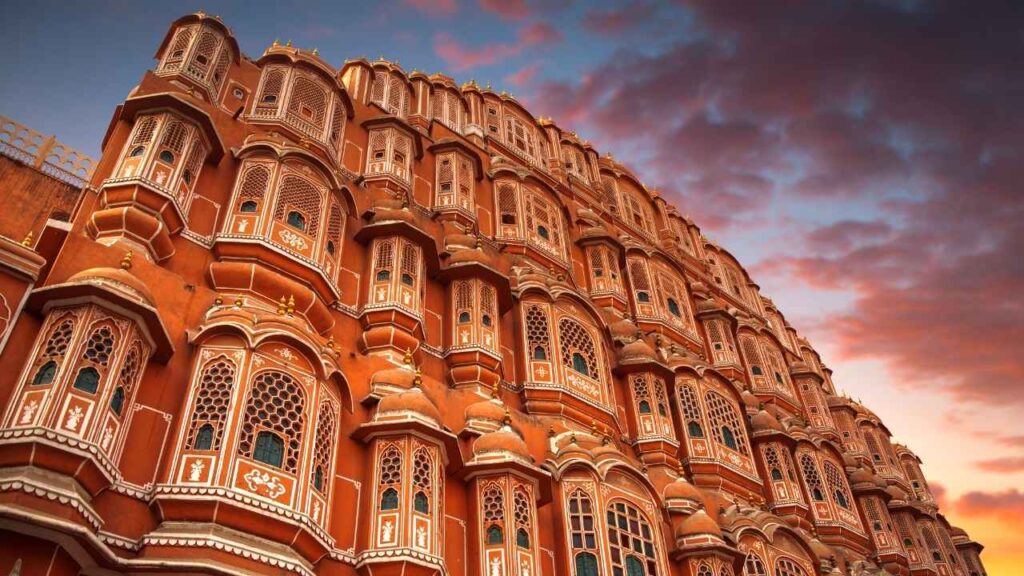
I remember the first time I went to Johari Bazaar and thought Hawa Mahal would amaze me. Instead, I found a mess. There were numerous visitors fighting for the same angle, street merchants yelling, and everyone’s attention was fixed on their phones instead of the monument. It was like standing in front of a painting you’ve seen a thousand times online, but everyone was too busy trying to get the best Instagram image to appreciate how smart it was.
At that point, I understood: most people don’t really view Hawa Mahal. They take pictures of it. They snap, they move on, and they mark it off their list. Hawa Mahal, the Palace of Winds, isn’t just a gorgeous pink building. It’s one of the best-designed buildings in India, with layers of significance, purpose, and history that are easy to see. So now I’m going to tell you what makes Hawa Mahal exceptional, beyond how it looks on Instagram.
The Truth About Hawa Mahal
Let’s begin with the figures. Since 2023, the number of international visitors to Jaipur has gone up by 140%, from 41,081 to 98,900 in 2024. Rajasthan alone welcomed 230 million domestic tourists that year, with 37.8 million arriving in only the first two months of 2025. Hawa Mahal is in the middle of this huge wave of tourists. For over 200 years, Hawa Mahal has been Jaipur’s most renowned landmark, yet most visitors remain unaware of its original purpose.
This is the story that the guidebooks don’t tell you: People were never supposed to live in Hawa Mahal. It served no purpose as a home, a temple, or a castle. Maharaja Sawai Pratap Singh, the king of Jaipur, built this building in 1799 for one reason: so that the royal women in his court could watch ordinary life and royal processions from the crowded Johari Bazaar below without being seen.
This era was the time of purdah, a way of life that kept women from royal households from being seen in public or by strangers. It was limiting, but it was also the world they lived in. Sawai Pratap Singh didn’t put them in jail, though. Instead, he came up with a clever way to keep them safe. He engaged architect Lal Chand Ustad, who got ideas from the Khetri Mahal in Jhunjhunu and constructed something that would become an architectural masterpiece.
The Brilliance of 953 Tiny Windows
This is when Hawa Mahal really shines. There are 953 little windows in the shape of a honeycomb pattern on five storeys of the building. Each window is no bigger than a peephole. It seems like a strong, fancy front from the street. From inside? This is a whole other story.
Each window has miniature shutters and latticework that has been carefully crafted. The lattice design serves two goals. First, it keeps things private. A woman standing behind the lattice window can see everything going on outside, but the lattice’s intricate carving and shadows make it almost difficult for someone on the street to look inside. Genius, huh?
But here’s the smart part: the design of the window isn’t simply for privacy. It’s all about physics.
The Secret Cooling System Nobody Talks About
No one talks about the secret cooling system. Hawa Mahal means “Palace of Winds,” and that term is not only a lyrical word. The honeycomb lattice design of the 953 windows makes the Venturi Effect, which is a physics principle. The small lattice windows let air in, which compresses and speeds it up. This generates air flow that cools the inside chambers. This passive cooling device saved lives in Rajasthan, where summer temperatures can reach above 45°C.
The architects made this cooling system even better by putting fountains in the middle of each room. The circulating air through the lattice windows and the water from the fountains made the room feel like it was air-conditioned long before mechanical AC was invented. Medieval climate control, essentially.
Take a moment to think about that. In 1799, when people were still fighting the heat with cloth and water, Lal Chand Ustad constructed a building that could regulate its own temperature using nothing but creative geometry and awareness of how air moves. That’s not simply building. That’s poetry about engineering.
The Architecture That Defies Logic
Another strange thing about Hawa Mahal is that it doesn’t have a foundation. Take a moment to think about that. A five-story, 50-foot-tall structure built solely on sand, with no substantial foundation work, yet it’s remained standing straight for almost 225 years. How?
The building’s curved outside wall leans at an angle of 87 degrees, which makes it stable. The form spreads the weight out so that it stays upright even though it doesn’t have a normal basis. Most buildings are built with foundations first, but Hawa Mahal was built as one whole structure, with the architecture itself serving as the engineering solution.
The building is also incredibly thin. The building looks huge from the street, yet it’s only one room deep. There are modest patios on the first and second stories, but the top three floors are only slightly wider than one room. So you’re looking at a huge facade that is really a shell. It costs a lot to build, but it uses space and materials very well.
The choice of construction material shows how much Sawai Pratap Singh cared about the little things. Hawa Mahal is made completely of red and pink sandstone, which is also utilized in other structures in Jaipur. This decision wasn’t a mistake. The buildings in the city all have the same color scheme on purpose, which gives the city a united look. Interestingly, Jaipur got the appellation “Pink City” because of the choice to paint (and then preserve) the city’s buildings pink.
The Rajput-Mughal Fusion That Changed Indian Architecture
Hawa Mahal is architecturally important not merely because of one novel idea, but because Lal Chand Ustad combined two very different styles of architecture to build something wholly new.
The edifice is shaped like Lord Krishna’s crown, which is a very Hindu design choice that shows how devoted Sawai Pratap Singh was. However, Rajputs drew inspiration from Mughal architecture for their arches, symmetry, inlay work, and lattice patterns. The chhatris (domed pavilions), the finely carved stonework, and the decorations all show how Rajputs create their buildings.
This blend held deeper significance than mere aesthetics. Maharaja Sawai Jai Singh II, who was known for blending many cultural and architectural styles, founded Jaipur in 1727. Sawai Pratap Singh continued this tradition. Hawa Mahal is a visible relic of a time when Hindu and Islamic architecture didn’t compete with each other; they worked together to make something amazing.
When to Go to Hawa Mahal So You Don’t Get Disappointed
This is where most travel websites get it wrong: time is vital at Hawa Mahal.
If you come between 11 AM and 4 PM, you’re going to have a bad time. The sun will be straight above, making shadows very dark. The throngs will be at their busiest. The heat will be oppressive, and the quality of light for shooting will be horrible. I’ve seen hundreds of Instagram images of Hawa Mahal taken at these times, and they all seem faded and messy.
Go instead between 8:00 and 10:00 in the morning. The Hawa Mahal faces east, so the gentle, golden light of the sun bathes the whole pink sandstone facade in the early morning. There aren’t many people here; maybe a tenth of what you’d see at noon. The air is cooler, you won’t sweat through your clothes in five minutes, and you can truly explore the inside without pushing through a sea of people. Try to go from Tuesday to Thursday. Weekdays are better than weekends.
The absolute greatest season is October through March. The temperature in Jaipur in the winter is between 10 and 27 degrees Celsius, which is comfortable. You won’t feel like you’re going into an oven when you climb the ramps to the top stories. Every day, the palace is open from 9:00 AM to 5:00 PM, but the magic hour happens just after it opens.
The Photography Angle Nobody’s Using Correctly
Most people take pictures of Hawa Mahal from the street, looking up at the front. Okay. But the real photography magic happens at the cafes directly opposite the monument.
Tattoo Cafe & Lounge and Wind View Cafe are right across from Hawa Mahal and have the best view of the whole building from above. If you grab a table on their terrace early in the morning, you get an uninterrupted, symmetrical shot of the facade with the mild morning light striking it perfectly. Photographers, especially serious ones, set up their tripods in these cafes.
The pictures taken from within Hawa Mahal are distinct. When you take pictures via the jharokhas, the lattice work makes wonderful bokeh effects. The interiors, with their diverse colored marbles and minimal decorating, give contrasting pictures. And if you get the timing perfect, you may get the morning light coming through the 953 windows, which makes thousands of little light patterns on the walls of the room.
A wide-angle lens (16–35 mm) is optimal for getting the whole front of the building. A lens with a range of 35 to 85 mm is best for close-ups and images of the inside. To get depth throughout the whole structure when shooting at sunrise, set your ISO low and your aperture between f/8 and f/11.
The Real Answer: What Makes Hawa Mahal Special
So, what makes Hawa Mahal so special?
The pink color helps, but it’s not the only thing. It’s not the 953 windows, even if they look great. The past is fascinating, but it’s not the point. It’s because Hawa Mahal is a brilliant architectural answer to a real human need.
Sawai Pratap Singh had an insurmountable constraint: royal women wanted to experience life, but societal conventions barred them from being seen. Most rulers would have merely responded, “Sorry, that’s the way it is.” He didn’t. He told his architects to find a solution, and they did. They built a place where people can see the palace and be seen at the same time. But women can watch through the windows without being seen.
That’s using architecture to solve problems. That’s also why Hawa Mahal has been around for 225 years. It wasn’t made to look good. It was made because it fixed an actual problem.
The system for passive cooling? That originated from the same way of thinking. Don’t just put up with the heat; change the architecture so that it works with nature. Use geometry and airflow instead of expensive materials and complicated engineering.
Every part of Hawa Mahal, from the lattice windows to the curving outside to the use of sandstone to the lack of a foundation, has a reason for being there. And that’s not common. Most historical sites are impressive because they are old or beautiful. Hawa Mahal is remarkable because it is smart.
The Full Experience: More Than Just the Monument
Most guides don’t tell you this about going to Hawa Mahal: it’s not a stand-alone monument. It’s a part of an ecosystem.
Walk out from Hawa Mahal into Johari Bazaar, and you’ll find street cuisine that’s been served from the same stalls for decades. Radhe Kachori Wala is renowned for its pyaaz kachori, a type of pastry filled with onions. The sellers sell all the favorites, like masala chai, pakoras, bhel, and chana jor garam. While you watch the bazaar come to life, eat.
Then head to Jantar Mantar, a UNESCO World Heritage site that’s only a short walk away. Astronomers have been measuring the universe there for 300 years. The Sargasuli Tower, sometimes named Iswari Minar Swargasuli, offers panoramic views of Jaipur, provided you can handle climbing the spiral staircase.
The Galta Ji Temple complex is worth the journey if you’re ready to go a little further. It’s a pilgrimage site in the hills outside Jaipur with stepwells and temples that few visitors ever see. Panna Meena Ka Kund is an old stepwell that looks lovely in pictures and is quiet. And if you want to see the sunset over water, Jal Mahal, a palace in the middle of a lake, is beautiful during the golden hour.
Hawa Mahal is not a place to go alone. It’s the anchor point for a much bigger investigation of Jaipur’s hidden layers.
Last Thoughts: Looking Instead of Taking Pictures
What do I think? When you go to Hawa Mahal again, put your phone away for at least 20 minutes. Take a walk around the building from different points of view. Pay attention to how the light hits the latticework at different times. The windows on the top floors let in a refreshing breeze. You may sit at Tattoo Cafe and observe the villagers as they go about their day, reminiscent of how royal women once watched from behind those small windows.
Hawa Mahal is not really a secret. It’s one of the most famous buildings in India. However, the design’s purpose is not immediately apparent. Once you know that, once you see the smart design, the social problem it solved, and the regard for people’s needs built into its architecture, you’ll look at Hawa Mahal in a new way. Not as a pink structure to cross off your list, but as a work of art that solves real problems.
And that’s what’s really special about it.