
Ask anyone about Jim Corbett and they’ll mention the tiger. Maybe the safari. Possibly the jungle. Nobody mentions the Koshi River. Jim Corbett’s relationship with this river runs deeper than most travel guides acknowledge—the river shapes the landscape, feeds the forest, and holds some of the most quietly extraordinary experiences in the entire region. I discovered this not because I planned to, but because a temple path was closed and I had nowhere else to go.
That accidental afternoon by the Koshi turned out to be one of the better parts of the trip. This post is about that.
What the Koshi River Actually Is
Before the Jim Corbett part, a brief note on the river itself. Because most visitors don’t know its story, and I think that context changes how you experience it.
The Koshi, also written as Kosi, rises in the Kumaon Himalayas and flows southward through the Terai region. By the time it reaches the Jim Corbett National Park area near Ramnagar, it has come through dense forest, carved out a wide rocky floodplain, and taken on a particular quality of water — clear, cold, and moving with a specific kind of purposefulness.
The river runs through and around the edges of the park. The Koshi River at Jim Corbett is not incidental to the wildlife—it’s one of the reasons wildlife is here in the first place. Animals come to the water. The forest is thicker near the banks. The birdlife is concentrated along the river corridor. And for humans, the Koshi riverbank offers something increasingly rare: a place to sit that asks nothing of you.
I didn’t know any of this before I went. I just knew there was a temple on a boulder in the middle of it, which sounded unusual enough to visit.
Girija Devi Temple: The One That Sits in the River
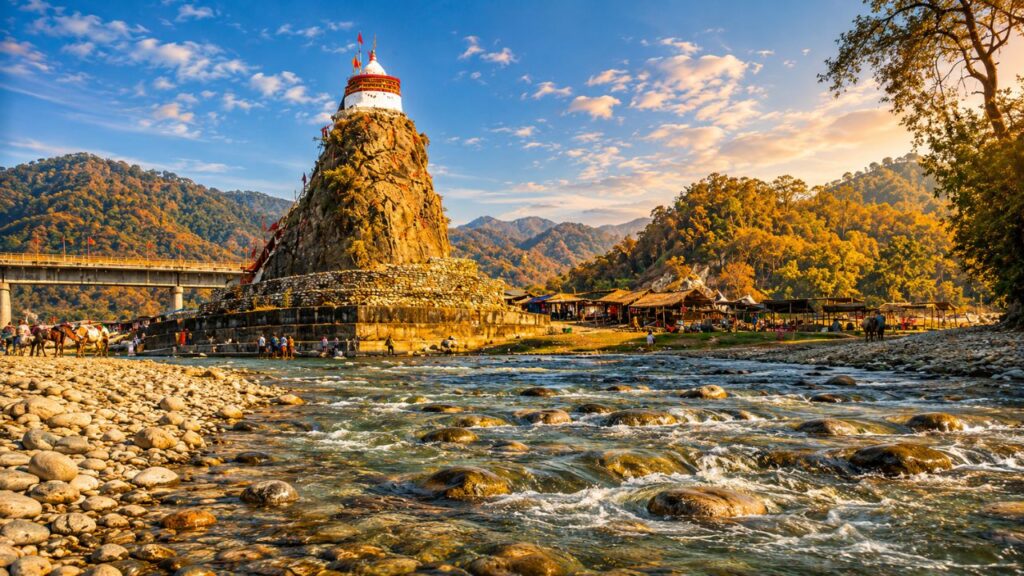
The Girija Devi Temple—also called the Garjiya Devi Temple—has one of the more dramatic settings of any temple I have visited in Uttarakhand.
It doesn’t sit on a hill. It doesn’t perch on a clifftop. It sits on top of a large boulder that rises out of the Koshi River itself. The river flows around it on all sides. The temple complex is up there, accessible by a walkway from the bank, looking out over the water with the forested hills of Jim Corbett in the background.
The first time you see it — and I mean the exact moment it comes into view from the approach road — there’s a brief pause where you just look and don’t say anything. It’s that kind of setting.
The temple is dedicated to Goddess Garjiya, a manifestation of Goddess Parvati. The name comes from “Garjiya village” nearby, and the temple has been a significant religious site for the Kumaon region for centuries. Locals visit throughout the year, but the big occasion is Kartik Poornima, when the riverbank fills with devotees who come to bathe in the Koshi and take blessings from Maa Garjiya. On that day, the temple is lit with diyas, the river reflects the light, and the whole scene is, by all accounts, extraordinary.
We did not visit on Kartik Poornima.
We visited on a regular afternoon when the path to the temple was closed. Construction work. A barrier, a sign, and a polite but firm indication that nobody was getting to the boulder that day.
When the Temple Door Closes
I want to write about this moment honestly because I think there’s something useful in it.
The immediate reaction was mild frustration. We had driven specifically to see this temple. The setting — the boulder, the river, the temple complex up top — was visible from where we stood. It was right there. And we couldn’t reach it.
There is a version of this where you turn around, note it as a failed stop, and drive to the next thing.
We didn’t do that.
Instead, we walked to the other temples in the complex nearby—smaller shrines, quieter, less photographed. We spent some time there. And then, almost without deciding to, we drifted toward the riverbank and sat down.
The Koshi was moving steadily in front of us. Wide, rocky, clear. The forested hills on the far bank. A few birds. A hot afternoon sun that wasn’t entirely comfortable, which is why we eventually moved on but for those fifteen minutes on that bank, with the boulder temple visible in the distance and the river doing what rivers do, something settled.
I’ve thought about that moment several times since. The closed path sent us somewhere we wouldn’t have gone otherwise. Which is a thing that happens in travel more often than we admit—the blocked door redirects you to the room that was actually worth entering.
If you visit the Koshi River Jim Corbett and the main temple path is accessible, go. The setting is worth it. But if it’s not, don’t leave. The river alone is reason enough to stay a while.
The Suspension Bridge Nobody Puts in Their Jim Corbett Itinerary
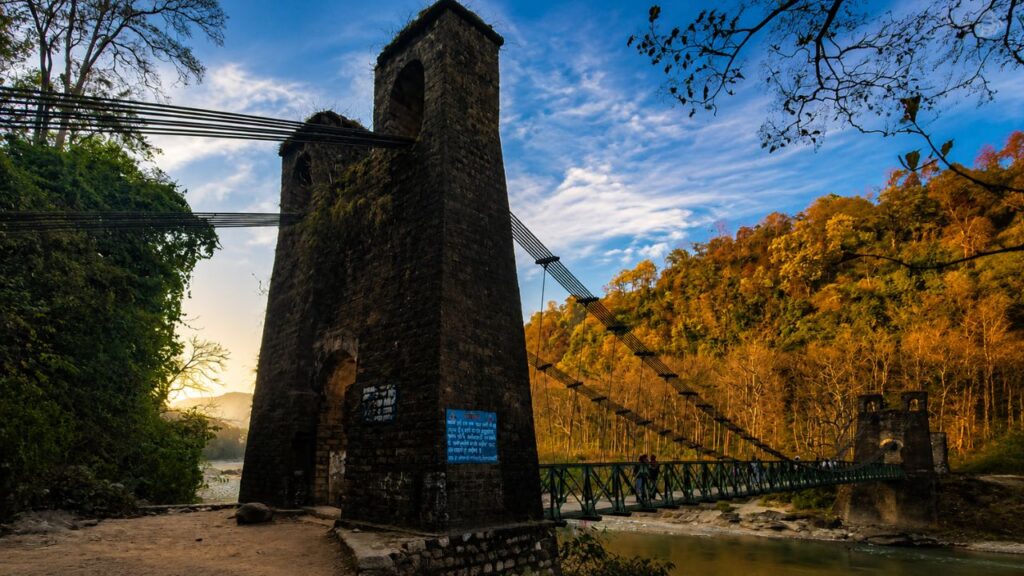
A few kilometers from the Girija Devi Temple, there is a suspension bridge that I had not read about in a single Jim Corbett travel guide. Not one. I found out about it from someone locally, almost as an afterthought: “There’s an old British bridge; you can walk across.”
We went.
It was not what I expected when someone says “suspension bridge.” This was heavy, old construction — the kind of infrastructure that the British built in India with the clear intention of permanence. It looked, honestly, more like a fortification than a crossing. Wide enough for foot traffic, solid as anything, and carrying that specific weight that very old things carry when they’ve been standing through decades of monsoons and river floods.
We crossed it on foot. The river was below and on both sides, visible through the structure. On the other side: rocks. The Koshi riverbank is flat and wide, with boulders smoothed by the river into comfortable sitting shapes.
We took off our shoes.
The water was cold — properly cold, the kind that makes you pull your feet back the first time and then slowly let them settle back in. The rocks underneath the water were smooth. The sound was constant—moving water, always moving. On the far bank, there is forest. Behind us, the old bridge. Above, an open sky.
What Happens When You Actually Stop
I want to be specific about what those thirty minutes at the suspension bridge felt like, because I think vague descriptions of “peace” and “nature” are the least useful thing a travel writer can offer.
We were a group of six. We weren’t meditating. We weren’t being particularly mindful. We were sitting on rocks with our feet in a cold river, talking the way people talk when there’s no agenda—loosely, tangentially, without destination. Someone said something funny. Someone else pointed out a bird. Someone just sat quietly and looked at the water.
That’s it. That’s the whole thing. And it was, without question, the most restorative thirty minutes of the entire day.
The Koshi River Jim Corbett does something to the pace of time. I don’t know how to explain this more precisely. It’s not silent — the water is audible constantly. It’s not dramatic—there’s no waterfall, no rapids, just a wide river moving through a wide rocky bed. But there’s a quality of aliveness to it that a pool or a lake doesn’t have. The river is going somewhere. It has been going somewhere for longer than any of us have been alive. Sitting next to it while it does that is somehow grounding in a way that sitting next to still water isn’t.
If you are ever at the Koshi River Jim Corbett bridge, take your shoes off. Sit on the rocks. Give it at least twenty minutes. Don’t photograph for the first five. Just be there first.
The River as Jim Corbett’s Real Soul
Here is the thing that struck me most about the whole afternoon.
Jim Corbett’s fame rests entirely on the tiger. The park exists because of the tiger. The safari industry exists because of the tiger. The permits, the zones, the guides, the jeeps — all of it because of one animal that you may or may not see.
I have nothing against tigers. They are extraordinary creatures, and I understand completely why people come specifically to look for them.
But the Koshi River was here before the park was established. It was here when Jim Corbett—the man, the hunter, the eventual conservationist—was walking these forests. It shaped this landscape. It sustained the wildlife the park now protects. It carved the valleys that the forest filled in.
The Koshi River at Jim Corbett is not a side attraction. It is one of the reasons Jim Corbett is what it is. The fact that most travel content treats it as a photo stop on the way to the safari gate is, I think, a genuine oversight.
The river is the long story. The safari is one chapter of it.
Practical Notes for Your Koshi River Visit
Since some of you will want specifics, here is what I know from the trip.
Girija Devi Temple timings: The temple is generally open from early morning to evening, with a midday break. The main festival is Kartik Poornima — if you can time a visit around it, the atmosphere is reportedly spectacular. Check current access conditions before visiting, as our experience showed that construction or maintenance work can close the approach path without much advance notice.
The suspension bridge: It’s a few kilometers from the temple, easily driveable. Ask locally for the “purana British pull”—most people in the area know it. There’s no signboard, no entry fee, nothing official about it. Just park nearby and walk.
Best time for the river: Early morning or late afternoon. Midday sun on an open rocky riverbank is harsh, which is why our visit was shorter than we’d have liked. The light is also better for photography at the edges of the day.
What to carry: Water, obviously — the rocky bank has no facilities. Footwear you don’t mind getting wet. If you’re going with children, the flat rocky areas near the bridge are safe and shallow, but the main river channel has current.
Combining it with the safari: Most people do the Girija Devi Temple as a Day 1 afternoon stop after checking in. The suspension bridge is a natural addition—both are close to the main resort clusters, and neither requires significant planning. Budget two to three hours for the combination, unhurried.
The temple when it’s closed: If the main path to the boulder temple is shut, don’t leave. The smaller surrounding temples, the riverbank, and the general atmosphere of the complex are worth your time regardless.
One Last Thing
On the drive back to the resort that evening, I found myself thinking—not about the tiger safari scheduled for Day 3, not about what we were cooking for dinner, but about the Koshi.
About how it had been there the entire time. Running through the forest, past the park boundaries, under that old British bridge, and around that boulder with a temple on it. While millions of visitors had passed through Jim Corbett over the decades looking up into the forest for a flash of orange and black, the river had just kept going.
It will still be going long after the last jeep has made its last safari run.
There is something reassuring about that. Something that I think is worth going to sit next to, at least once, with your shoes off and your phone in your bag.
The Koshi River Jim Corbett is not the main event. But it might be the one you remember longest.