
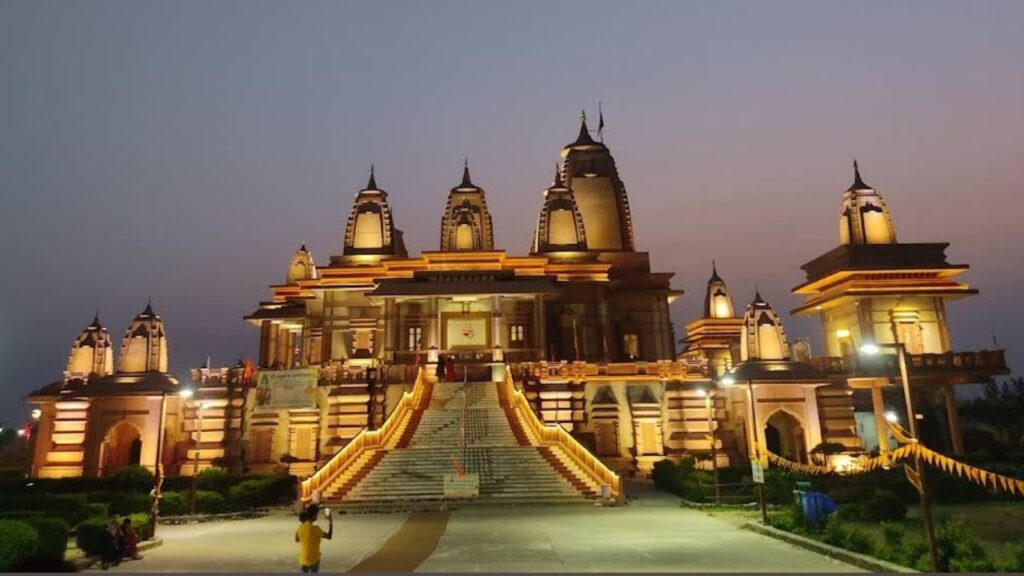
I want to be upfront about something: I didn’t expect much.
We were on Day 2 in Jim Corbett; the morning was still early, and Hanuman Dham, Ramnagar, was the first stop—a recently opened temple complex that nobody in our group had read about in advance. The name had come up locally. Someone had mentioned it. We had put it on the list without any particular anticipation.
Hanuman Dham, Ramnagar, opened its doors on November 17, 2025. A new temple. New construction, new premises, new everything. And I’ll confess—new temples don’t always move me the way old ones do. There’s something about centuries of accumulated prayer that ancient temples carry, a weight that fresh stone hasn’t had time to absorb.
I was wrong to apply that logic here.
What we found at Hanuman Dham was not just a new temple. It was a devotional experience built with a specificity and intention that made the newness irrelevant within the first few minutes.
The Premises — First Impressions
The scale hits you before anything else.
Hanuman Dham, Ramnagar is not a roadside mandir. The premises are large—a proper complex, with a defined boundary, a garden that has been laid out with care, and an atmosphere that separates itself from the surrounding area the moment you step in.
The first thing I noticed was the flag.
A large saffron flag, the kind that moves properly in a breeze, carrying the words Jai Shri Ram in bold. It flew above the complex with that particular authority that only devotional flags seem to have—not decorative, not incidental, but present in a way that signals what kind of place this is before you’ve seen anything else.
The garden inside the premises was tended and green. This matters more than it sounds. A well-kept garden around a temple says something about the people who maintain it—that the space beyond the inner sanctum is also considered sacred and that beauty and devotion are not separate concerns here.
We also noticed construction on one side of the premises—rooms being built for devotees to stay. A dharamshala in progress. The intention being that Hanuman Dham, Ramnagar, would not just be a stop on an itinerary but a destination in its own right—a place where people could come, stay, and spend time in devotion rather than passing through.
That ambition, visible in the scaffolding and unfinished walls, told me something about the people behind this temple. They were building for permanence.
Three Temples in One Complex
The main Hanuman temple is the centerpiece, but Hanuman Dham, Ramnagar is more than one structure.
Within the complex there is also a temple dedicated to Maa Durga and a separate one for Lord Shiva. Three deities, three distinct spaces, all within the same premises. For a devotee making a single visit, this is a complete spiritual experience — the energy of each deity, each form of the divine, encountered in sequence.
The Shiva temple in a forest-adjacent area like Jim Corbett carries its own significance. The Corbett region is deeply connected to the Ramayana—Sitabani, nearby, is the forest where Goddess Sita is said to have spent her exile, where Siteshwar Mahadev marks the spot where she worshipped Lord Shiva. A Shiva temple in this landscape is not incidental. It sits within a geography that has been sacred for millennia.
The Durga temple adds another dimension. The three together—Hanuman, Durga, and Shiva—form a theological completeness that a single-deity temple doesn’t have. It’s the difference between a paragraph and a full chapter.
The Bhajans
Before I describe the idols—which is the heart of this post—there’s something that sets the context for everything we saw inside.
Priests were singing bhajans.
Not recorded bhajans played through a speaker, which is what many temples use now. Live voices. The particular reverberation that a purpose-built temple space creates when human voices fill it.
The bhajans changed the quality of what we saw. This is not mystical — it’s acoustic and psychological. When devotional music is playing in a space, the things you look at in that space look different. The idols, which are objects of craft and devotion both, seem more alive when sound is moving around them. The atmosphere becomes participatory rather than observational.
We spent our time at Hanuman Dham, Ramnagar, inside a sound that was actively devotional. Whatever you believe about temples and prayer, that is an experience that registers.
The Idols — Each One a Different Story
Photography inside was not permitted. I respect that completely—there is something right about spaces where the camera is asked to stay outside, where the only recording device allowed is memory.
What I can tell you is what I saw. And what I saw was remarkable because of its variety.
Hanuman Dham Ramnagar does not have one idol of Hanuman Ji. It has multiple—each in a different pose, different material, different mood. Most temples present a single primary murti. Here, each idol was fully realized, fully adorned, and entirely distinct from the others.
The Golden Hanuman — Two Presentations
Two of the idols were golden—deep, warm, burnished gold—presented in enclosed glass shrines surrounded by offerings of flowers in yellow, pink, purple, and blue. Both carried the classic attributes—the gada, the flame torch—but their adornments differed completely. One wore an elaborate blue and orange embroidered vestment with intricate gold borders, an ornate silver mukut, and garlands of red flowers layered across the chest. The other was dressed in pure gold and yellow, with a white floral garland at the neck.
These two felt like the warrior and the devotee—same deity, different expressions of the same divine nature.
The Seated Scholar
One idol stopped me completely. A seated Hanuman—white marble, in a pose of learning. He held a scripture open before him, reading. The posture was not the typical standing warrior stance. It was contemplative and internal, the posture of a being engaged with knowledge rather than battle.
The marble was intricate. The columns of the surrounding arch were carved and detailed. A yellow and gold vestment covered the seated form, with marigold garlands at the neck. The expression—and marble expressions are difficult to achieve with any subtlety—conveyed something genuinely peaceful.
The devotional tradition around Hanuman emphasizes strength, service, and devotion. This idol emphasized wisdom. It was a reminder that the same divine presence holds all of these qualities simultaneously—that the being who crossed the ocean to Lanka also sat with the scriptures.
The Blessing Stance
Another marble idol— standing in the abhaya mudra, the right hand raised in blessing. Orange and gold vestments. An ornate white marble arch behind, with a cascade of crystal beads falling from the ceiling like a curtain of light. Two carved swans in red and white on the backdrop, a classical motif.
One hand blessing, one hand holding the gada at rest. The posture carried the specific weight of someone who has been through fire and knows what they are made of. Not aggressive, but authoritative. There is a difference.
The Sankat Mochan
The idol that most visitors will stand before longest is the one that shows what Hanuman Ji carries inside—the form where his chest is open, revealing Ram and Sita at the center of his being. A white marble, jeweled crown with red and silver detailing, fully adorned in orange and gold.
This is the image the devotional tradition returns to again and again because it answers the most direct question: what is Hanuman? The answer is in his chest. He is Ram Bhakt. The deity and the devotee. The most powerful being in the Ramayana, entirely given over to someone else.
That theology — service as the highest form of strength — is not a small thing to encounter on a morning in Ramnagar.
Why a New Temple Can Still Feel Old
I said at the beginning that new temples don’t always move me. Let me return to that honestly.
What Hanuman Dham, Ramnagar, taught me is that newness and sacredness are not the same axis. A temple is not old or young based on its stone. It’s old or young based on the intention it was built with and the quality of attention it receives.
The idols at Hanuman Dham, Ramnagar, were chosen and commissioned with care. Each one represents a different dimension of the same divine presence. The bhajans were sung by people for whom it genuinely matters. The garden was tended. The flag flew. Rooms are being built so that people who want to stay can stay.
This temple is young in years and old in intention.
There are ancient temples in India that feel hollow—dusty, commercial, going through motions. And there are new temples, like this one, that carry something genuine from the moment they open. Hanuman Dham, Ramnagar is in the second category. And I say that as someone who arrived expecting very little.
The Significance of This Location
One more thing worth noting — something that struck me only after we’d left and I’d had time to think about the region as a whole.
The Jim Corbett area is layered with devotional geography in a way that most travel writing doesn’t acknowledge.
The Sitabani forest, nearby, is where Maa Sita spent her exile. The Siteshwar Mahadev temple inside the Sitabani zone marks where she worshipped Lord Shiva. The Koshi River holds the Garjiya Devi temple on a boulder in the middle of the water. And now there’s Hanuman Dham, a new complex dedicated to the devotee who was closest to Ram and Sita through every moment of the Ramayana.
These are not separate, unconnected dots. The forest region around Ramnagar and Jim Corbett sits inside a geography that the Ramayana touched. The temples — ancient and new — are responses to that geography. They are a community’s way of saying, “This land is not just wildlife habitat.” It is also something else. Something older.
Visiting Hanuman Dham, Ramnagar, understanding where you are and what surrounds it, is a different experience from a routine temple stop.
It’s worth going with that context in mind.
Practical Notes on Hanuman Dham Ramnagar
Location: Near Ramnagar, Jim Corbett region. Search “Shri Hanuman Dham Ramnagar” on Google Maps.
Photography: Not permitted inside the temple.
Timings: Morning darshan and evening puja. Midday gap. Confirm current timings locally or with your resort before visiting.
Dress code: Standard temple requirements. Covered shoulders, covered legs. Footwear removed at entry.
Time to allocate: Minimum one hour. The premises are genuinely large, three temples need attention, and the Hanuman idols reward unhurried looking. Don’t rush this.
Accommodation: Rooms within the premises under construction at time of visit. May be operational by the time you visit—worth checking if a temple-complex stay appeals.
Best combined with Corbett Falls, Corbett Museum, and Barati Rau waterfall—all within reasonable distance. A full Day 2 itinerary that covers spiritual, natural, and historical ground.
One Last Look
On the way out, I looked back once more at the complex. The garden, the white marble visible from the gate, and above everything—the saffron flag moving in the morning breeze. Jai Shri Ram.
Jim Corbett is famous for its jungle and its tiger. The Corbett region, as this trip kept reminding me, carries a deeper layer—the river with its boulder temple, the forest where Sita walked, and this new temple complex that opened its doors in November 2025 and already carries more weight than most places manage in decades.
I came to Jim Corbett for the tiger. The region gave me temples instead.
Given what the temples turned out to be—I think I came out ahead.