
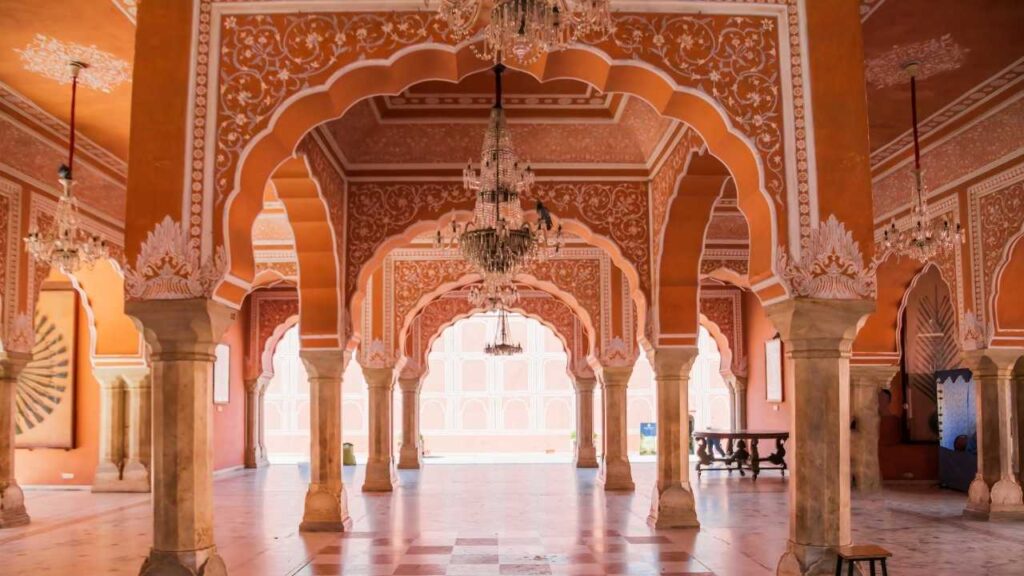
I stood in the courtyard of the City Palace in Jaipur with my camera hanging uselessly around my neck. Hundreds of tourists took the same picture of the colorful gates of Pritam Niwas Chowk that I did. Peacock Gate. The Rose Gate. Gate in Green. The Lotus Gate. Yes, it’s beautiful. But no one was wondering why these gates were there. No one knew about the design conspiracy that was going on behind these walls. And that’s when it hit me: nearly no one really sees City Palace Jaipur, even if many people go there.
Famous monuments are like prisons because their fame keeps them there. Every year, thousands of people visit the City Palace in Jaipur, yet most of them just see the surface splendor. They’ve taken pictures of the palace, but they haven’t found it. They’ve been there, but they haven’t figured it out. Visiting Jaipur or having a passion for India’s architectural history? What I’m about to share will forever transform your perspective of City Palace Jaipur.
This isn’t simply another book about travel. This is the tale of secrets—architectural, historical, and profoundly human—concealed within these walls, hidden from the average traveler’s view.
The Palace That Doesn’t Follow Any Rules
Here’s something that will startle you: City Palace Jaipur is not empty. It’s not a museum that is closed on Sundays. It’s not just an old building that hasn’t changed. The royal family of Jaipur still lives here. Right now. While you’re reading this!
City Palace Jaipur, built by Maharaja Sawai Jai Singh II between 1729 and 1732, is a one-of-a-kind building in India’s architectural environment. It’s a castle that is alive. Not a statue. Not a museum. A home. And this one fact affects everything about how you should feel about it.
When Maharaja Jai Singh II thought of City Palace Jaipur, he didn’t think like a normal rajah. He was thinking like an urban designer, an astronomer, and a diplomat. The designers did not primarily construct the palace for military defense or solitary luxury; instead, they envisioned it as the cultural and administrative hub of a nascent city. This difference is important because it shows why City Palace Jaipur is so different from other palaces you may have seen.
Most palaces don’t seem to be part of the city around them. City Palace Jaipur seems to be part of it. Unlike the Amer Fort, the palace isn’t on top of a hill. It’s not hidden behind military barriers. It is inside the city walls, easy to get to, see, and use. In 1729, this was a new way of thinking.
Secret #1: The Four Doors Philosophy (And What Your Guide Won’t Tell You).
Everyone who visits City Palace Jaipur sees the four gates of Pritam Niwas Chowk. The Gate of the Peacock. The Gate of Roses. The Green Door. The Lotus Gate. They are beautiful. Too complicated to understand. But practically no one knows what they really mean, and knowing what they mean transforms how you see the castle completely.
These gates weren’t simply for looks. They were the whole philosophy.
The Peacock Gate (autumn) was built in honor of Lord Vishnu, the god of preservation and cosmic order. The Rose Gate (winter) represents the Goddess Lakshmi, the divine feminine force. The Green Gate (spring) was a tribute to Lord Ganesha, who is the god of new beginnings and the one who removes obstacles. The Lotus Gate (summer) honored Shiva and Parvati, the celestial couple who stand for equilibrium and the cosmic dance.
A common thing for a tour guide to say is, “These four gates stand for the four seasons.”
What they don’t tell you is that this design was based on the Hindu idea of universal cycles, which says that nature, divinity, and human life are constantly changing. The Maharaja was doing more than just building a palace. He was making a tangible representation of Hindu thought. The gates continuously reminded every courtier of the cycle of life, the balance of forces, and humanity’s role within cosmic order.
This is what separates visiting from unraveling. City Palace Jaipur is more than just a building; it’s a spiritual text in three dimensions.
Secret #2: Jaali work is a brilliant way to change the weather in ancient India.
City Palace Jaipur has a lot of beautiful latticed screens called “jaali.” They are lovely. They are quite popular among photographers. But they also show that engineers were brilliant hundreds of years ago, and modern architects are only now starting to figure it out.
Those fragile latticed screens did three things at once:
First, privacy. Women in the palace could see the outer world without being noticed. Tradition hides power.
Second, ventilation. In the sweltering heat of Jaipur, these jaalis let air flow naturally without having to open the palace doors.
Thirdly, they serve to disperse light. The jaalis let in soothing, dispersed light instead of harsh, straight sunshine that flooded the rooms.
Biomimetic architecture is when we learn from how nature solves problems and use those ideas in our buildings. The ancient Rajput architects who built City Palace, Jaipur, knew about thermodynamics, optics, and aerodynamics long before these became established sciences.
When you see jaali art in City Palace Jaipur, you’re not seeing adornment. You are looking at problems that have been fixed. You’re seeing designs that work with nature instead of against it.
Secret #3: Chandra Mahal, the Seven-Story Code
This is where City Palace Jaipur, really starts to become strange.
The Chandra Mahal (Moon Palace) is a seven-story building that is the main part of the complex. Most people who come to see it don’t go inside. Most people don’t even arrive near. If you pay for the Royal Splendour ticket (₹3,500 per person), you can get to levels that show the Maharaja’s whole worldview through architecture.
There was a name and purpose for each floor:
- Ground floor: Sabha Niwas (Hall of Assembly), for government work and formal meetings.
- The first floor is the Sukh Niwas (Hall of Rest), which is the royal dining area. It has calming hues and flowery motifs.
- Second floor: Rang Mandir (Hall of Colors), where every surface gleams with elaborate mirror work.
- Third floor: Chhavi Niwas (Hall of Mirrors), this was the Maharaja’s monsoon refuge, and it was painted in bright blue and white. It is also known as “The Blue Room.”
- The fourth story is called Shobha Niwas (Hall of Beauty) and has gold leaf decorations and the most intricate mirror work in the whole palace.
- Fifth and sixth floors: Shri Niwas and Mukut Mandir. These are the higher rooms where religious rites and private events take place.
- The royal flag flies on the seventh floor while the Maharaja is there.
What I consider intriguing is that the palace doesn’t go up; it goes in. The floors become smaller as you go up, making a perfect pyramid shape. This phenomenon didn’t happen by chance. In Hindu numerology and Vastu Shastra, which is an ancient Indian discipline of architecture, going up seven levels means going from dealing with tangible things (ground-level administration) to spiritual growth (the crown temple).
You’re not just going up steps. You’re moving up a spiritual ladder that is written in stone and mirror.
Secret #4: The Water Vessels That No One Talks About.
Tourists take pictures of something in the Diwan-I-Aam (Hall of Public Audience) part of City Palace Jaipur, but they don’t know what it is.
Gangajalis is the name of two huge silver vessels. They’re huge, the biggest silver vessels ever made. And so they acquire a place in the Guinness Book of Records.
A common guide might add, “These held holy water.”
The truth is much more political: these vessels stood for the Maharaja’s dominion over water itself. In a desert kingdom where water was practically life, being able to own and move 4,000 liters of sacred water (typically from the Ganges) was a sign of total dominance. It said, “I am responsible for life itself.”
The Maharaja would take these vessels with him on his trips to show other kingdoms that he could still gain access to sacred, life-giving resources even while he was away from home. This was medieval geopolitics encoded in silver.
Secret #5: The Observatory Connection (Maharaja Jai Singh’s true love)
Historians talk about this, but tourists never put it together: Maharaja Jai Singh II, who built City Palace Jaipur, was genuinely interested in astronomy.
He built five Jantar Mantar observatories in India. He wrote letters to scientists across Europe. And he was trying to make sense of Hindu astronomy and Copernican physics. This was also a problem for European institutions in the 1700s.
The City Palace Jaipur is built in a way that makes it look like it is in space. The design is based on Vastu Shastra, which is based on how the stars line up. The palace was built with astronomical accuracy, with its alignment with cardinal directions, the arrangement of courtyards to catch certain angles of sunlight, and the strategic placement of viewing chambers.
You are strolling through a three-dimensional astronomical instrument when you walk into City Palace Jaipur. The palace doesn’t merely mirror cosmic order. It’s set to it.
How to Really Experience the Hidden Secrets: Useful Information
Let me give you something that every tourism site doesn’t: honest, useful advice.
Fees to Get In:
Entry for the general public: ₹200 for Indians and ₹700 for foreign visitors.
Royal Splendour ticket (private rooms access): ₹3,500 per person (includes a private tour and complementary chai—this is totally worth it)
You can book the tickets online to skip the queue.
Hours:
Open every day from 9:30 AM to 5:00 PM.
Visits at night are from 7:00 PM to 10:00 PM (you need a special ticket).
Best Time to Visit:
The best time to visit for taking pictures is in the morning, between 8:00 and 10:00 AM. The sun shines on the Chandra Mahal at just the right angle, bringing up the fine details without making any harsh shadows. Don’t go in the middle of the day when the sun is above. It washes out colors and makes things look flat. Your second best choice is late afternoon (2:00–4:00 PM).
A 24–70mm lens is ideal for taking pictures within the palace. You can bring a tripod. The Blue Room (Chhavi Niwas) is primarily in the shade, so you’ll need a quick aperture and steady hands. Drones are not allowed at all.
What Most Guides Won’t Tell You:
The Royal Splendor ticket holders receive quieter access. While the public fills the courtyards, you will be exploring apartments in the palace that are mostly empty. This significantly alters both your experience and the quality of the pictures you take.
The True Story of City Palace Jaipur
You don’t simply see architecture when you go to City Palace Jaipur. You are watching a civilization’s attempt to put its most important ideas about science, religion, and philosophy into physical form.
Maharaja Jai Singh II sent a message across time: “We knew about the universe.” We got the hang of the weather. We combined spirituality with running a business. We found a balance between old and new.
The royal family still lives in the palace because they know this history. They could have turned it into a proper museum years ago. They might have left it behind for new houses. Instead, they keep it as a living heritage—imperfect, lived in, and authentic.
This is what makes City Palace Jaipur different from all the other palaces in India. It’s not frozen. It’s not about performance. It’s history in action.
Before You Go, Ask Yourself
Don’t only take pictures when you go to City Palace Jaipur. Don’t just stroll through it. If you stand in Pritam Niwas Chowk, ask yourself, “What cycle am I stuck in?” What times of year shape my life? What am I building that will outlast me?”
The Maharaja didn’t ask these questions at random. He embedded these queries into the palace itself.
City Palace Jaipur isn’t only a tourist site. It’s a mirror. And if you look intently enough, you might find yourself mirrored in its walls.