
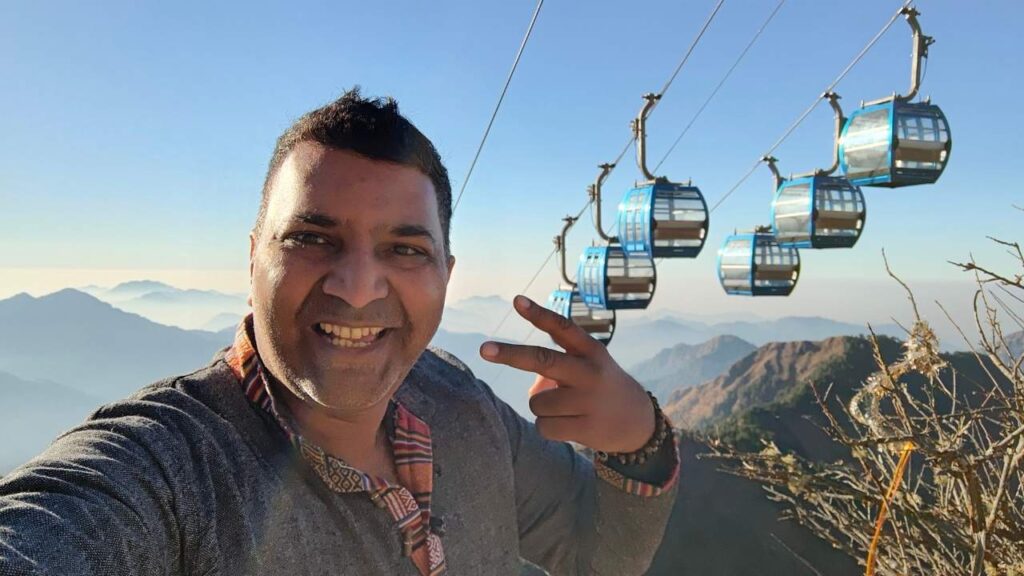
There’s a moment on every trip where Google Maps can’t help you, and “shortest route” stops mattering. For me, that moment was on the Surkanda Devi trek from Mussoorie, standing at the base, looking up at the steep stairs… while a shiny ropeway waited right next to it.
Everyone around me was excited about the cable car. I was tempted too. Five minutes in the gondola, no sweat, easy darshan. But something in me whispered, “You didn’t come all this way just to sit and glide.” So I did the dramatic thing: I walked, while everyone else flew.
This is my honest, no-filter guide to the Surkanda Devi trek from Mussoorie—trek vs ropeway, the truth behind the Instagram pictures, and whether it’s really worth choosing the hard way.
Where Exactly Is Surkanda Devi from Mussoorie?
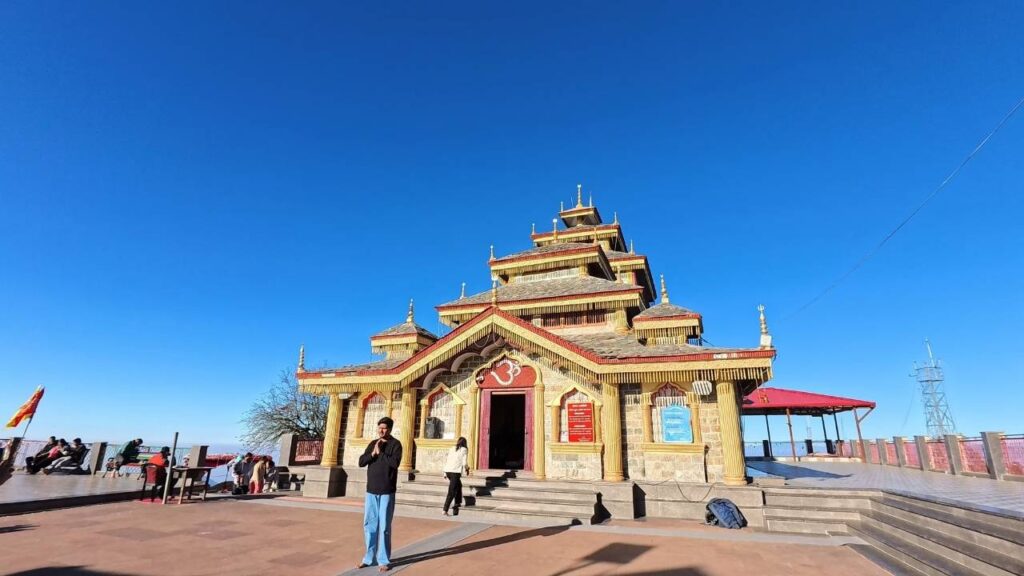
Surkanda Devi Temple sits on a hilltop in the Tehri Garhwal district of Uttarakhand, on the Mussoorie–Chamba highway near the village of Kaddukhal.
From Mussoorie, the drive to Kaddukhal is about 34–40 km, and it typically takes between 45 minutes and 1.5 hours depending on traffic and road conditions. You’re basically following a beautiful ridge road, with Mussoorie on one side and Dhanaulti and Kanatal in the broader neighborhood.
The temple itself sits at an altitude of roughly 2,757–2,760 meters (around 9,040 feet) above sea level, which means you really do feel like you’re walking into the sky as you get closer.
Why Is Surkanda Devi So Important?
Surkanda Devi is not “just another hill temple” you tick off a list. It’s considered one of the 51 Shaktipeeths, the sacred spots where parts of Goddess Sati’s body are believed to have fallen when Lord Shiva performed his tandav after her death.
According to the local belief, Sati’s head fell at this spot, which is why this temple is revered as a Siddhpeeth and draws both serious pilgrims and curious travelers.
Add to that:
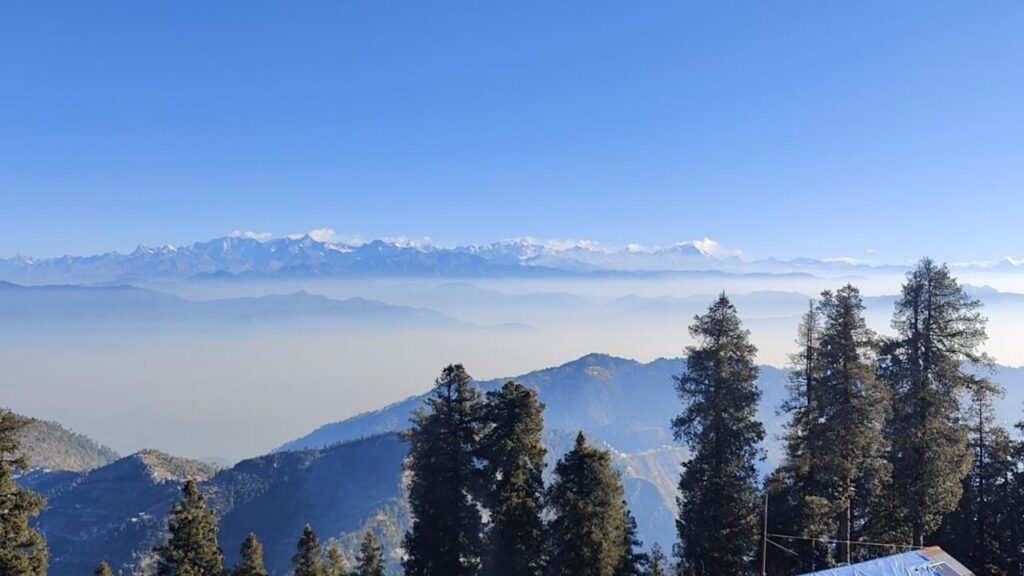
- Panoramic views of snow-clad Himalayan ranges on a clear day
- Forested approach filled with oak and rhododendron in season
- Cool weather almost year-round, with chances of snow in winter
So even if you’re not deeply religious, the mix of mythology, views, and trekking makes the Surkanda Devi trek from Mussoorie a really attractive day trip.
Trek Stats: How Hard Is the Surkanda Devi Trek From Mussoorie?
Let’s talk numbers before emotions. Because your knees and lungs will definitely ask for the data later.
Most sources agree on a few key facts:
- Trek starting point: Kaddukhal (on Mussoorie–Chamba road)
- Trek distance: Roughly 2–2.5 km one way, depending on where you start counting
- Elevation gain: From around 8,190 ft to about 9,040 ft, so a gain of ~850 ft in a short distance
- Average time: About 1–1.5 hours one way for a reasonably fit person, and up to 2 hours with plenty of breaks
- Trail type: Mostly cemented path and stairs, with continuous ascent and some steep sections; fenced on the valley side
Is the Surkanda Devi trek from Mussoorie very technical? No.
Is it a “casual evening walk”? Also no.
It’s a short but steep climb. If you live at sea level, are not used to stairs, or travel with kids/older parents, you will feel it. But that’s also what makes the payoff so satisfying at the top.
The Ropeway: The Easy Way Up (On Paper)
In 2022, Uttarakhand inaugurated a 502-meter-long ropeway from near Kaddukhal to near the temple, designed to make the climb easier.
Some key stats about the ropeway:
- Length: Around 502 metres
- Journey time: About 5 minutes one way
- Capacity: Up to 500 people per hour, which is huge for festival days and weekends
- Ticket price: Listed around ₹225 per person for the ride, as per recent ropeway information.
The ropeway has had a big impact: local reports mention that after it started, the number of devotees visiting the temple increased up to three times, especially helping women, kids, elderly, and differently abled devotees who might struggle with the steep climb.
So if you see long queues at the ropeway counter, it’s not just “lazy tourists”; it’s also people for whom the trek is genuinely tough or medically inadvisable.
Trek vs Ropeway: What Google Doesn’t Tell You
On paper, the choice between trek and ropeway looks simple. But travel decisions rarely stay on paper.
Here’s how the Surkanda Devi trek from Mussoorie actually felt, compared to taking the ropeway.
1. Time vs Experience
- Ropeway: 5–10 minutes, fixed window of views through glass.
- Trek: 60–90 minutes with the freedom to stop at multiple viewpoints, breathe, click photos, and just exist in the moment.
If your only goal is quick darshan and you’re rushing back to Mussoorie the same day, the ropeway is obviously time-efficient. But if you want to feel the mountain under your feet and let your mind catch up with your body, the trek wins every time.
2. Physical Effort vs Emotional Reward
The Surkanda Devi trek from Mussoorie is definitely a workout. That continuous stair climb at altitude gets your heart racing in the first 10–15 minutes.
But with every switchback, you watch the valley drop away, the horizon widen, and the clouds slowly settle below you. That slow transition from “I can’t do this” to “I actually did this” is a feeling no ropeway can give.
The ropeway gives you views.
The trek gives you a relationship with the hill.
3. Crowds vs Solitude
Because the ropeway can ferry up to 500 people an hour, the temple area near the ropeway exit tends to get crowded, especially around weekends and yatra seasons.
On the other hand, the walking trail, especially if you start early, often has stretches where it’s just you, the trees, and the sound of your breath. For a Shaktipeeth, that quiet approach feels more aligned with the energy of the place.
4. Accessibility vs Intention
The ropeway has genuinely opened up the Surkanda Devi trek from Mussoorie to people who could never have attempted the climb—older pilgrims, people with knee issues, and families with tiny kids.
So the question isn’t “ropeway is bad, trek is pure.” It’s really, “What is your intention for this visit?”
- If you are physically able and want a deeper, slower, more embodied experience, walk.
- If you or your companions have health constraints, or if time is extremely tight, take the ropeway without guilt.
My Personal Experience: Why I Walked While Everyone Flew
When I reached Kaddukhal that chilly December morning, our group naturally split into “ropeway people” and “let’s see how it goes” people.
Everyone looked up at the stairs, checked the time, and mentally calculated energy vs. reward. The ropeway queue looked manageable. The ride looked fun. The gondolas gliding in the air had that “reel-friendly” vibe.
And yet, the Surkanda Devi trek from Mussoorie felt like an invitation—to slow down, to earn the view, to sit with my thoughts. So, I chose the hard way.
The first 15 minutes were tough. My legs complained. My city lungs complained. I stopped at a tiny shop for chai and realized the auntie who runs it climbs this path twice daily like it’s nothing. Instant humility.
Halfway up, the views opened. The lower hills dropped away, and the Himalayas started peeking through the haze. I watched a gondola slide silently overhead and smiled. They would reach faster. I would reach fuller.
By the time I touched the temple courtyard, my legs were jelly, my hoodie was damp, and my heart was weirdly light.
Inside the temple, the bells sounded the same for trekkers and ropeway riders. The Goddess doesn’t differentiate. But for me, standing there knowing I had climbed those hundreds of meters myself made the darshan deeply personal.
That’s my truth: the Surkanda Devi trek from Mussoorie isn’t about proving fitness; it’s about proving presence to yourself.
Practical Guide: Planning Your Surkanda Devi Trek From Mussoorie
Let’s get into logistics so you can actually plan this.
Reaching Kaddukhal From Mussoorie
- The distance is around 34–40 km by road, depending on where in Mussoorie you start.
- The travel time is approx. 1–1.5 hours in normal conditions.
- Options:
- Hire a taxi from Mussoorie
- Self-drive if you’re comfortable with hill roads
- Occasional buses/shared cabs on the Mussoorie–Chamba route
Best Time for the Trek
- The most ideal seasons are March–June and September–November for clear skies and comfortable temperatures.
- In winter, during December–February, there can be snow and icy patches—magical but slippery, so wear proper shoes and warm layers.
- Avoid heavy monsoon days when trails can be wet and visibility low.
What to Carry
For the Surkanda Devi trek from Mussoorie, keep it simple but smart:
- Good walking shoes with grip (avoid flat sandals)
- Water bottle (there are shops but don’t rely on them alone)
- Light snacks (nuts, chikki, fruit)
- Layered clothing—it can be windy and significantly cooler at the top
- Small cash for prasad, tea and ropeway if you change your mind
When You Should Definitely Choose the Ropeway
Even as a trek lover, I’ll say this clearly: there are moments when the ropeway is the right choice.
Choose the ropeway if:
- You’re travelling with elderly parents, very young kids or anyone with knee/heart issues
- You’re visiting during a hot afternoon and are not acclimatized to the altitude.
- You have limited time and still need to drive back to Mussoorie, Tehri or Dehradun the same day
- The trail is snowed out or icy, and you don’t have the right shoes
The ropeway has made the Surkanda Devi trek from Mussoorie more inclusive, and that’s a beautiful thing. Accessibility is not the enemy of “authentic” travel; it just gives more people a chance to show up.
When the trek is absolutely worth it
On the other hand, if you:
- Crave a quiet walk with long pauses and deep breaths
- Want to feel you’ve earned the darshan after some honest effort
- Are working on your fitness and need a realistic but doable challenge
- Love photography and want more than a few ropeway window shots
…then please, choose your legs over the gondola.
The Surkanda Devi trek from Mussoorie packs a lot into 2–2.5 km—steep sections, forest patches, valley views, and changing light. It’s short enough to finish in half a day but impactful enough to stay with you for years.
My Honest Recommendation: How To Decide In 30 Seconds
Here’s my simple decision framework, friend to friend:
- Do you have any significant health issues, elderly parents, or children under the age of six?
→ Ropeway, guilt-free. - Are you reasonably fit, walk 5–6k steps daily, and love views?
→ Trek up, ropeway down if needed. Best of both worlds. - You’re short on time but stubborn like me?
→ Start early from Mussoorie, trek up at your pace, keep a hard turnaround time, and take the ropeway or a quicker descent if needed.
Whatever you choose, let your intention be clear. You’re not competing with anyone. You’re just choosing how you want to arrive at a sacred place—breathless from effort or calm from a gentle glide. Both are valid.
For me though, if I go again, I know my choice: I’ll still walk while everyone else flies.