
You don’t see it coming. That’s the first thing to know.
We had been in the Sitabani zone for over two hours. Open jeep, jungle road, morning light doing things to the forest that I couldn’t quite photograph accurately. The guide had taken us deep in; we’d found tiger pug marks, waited, and moved on. It had been a proper jungle morning.
And then—near the end of the safari—the guide said there was a temple nearby. Did we want to see it?
We said yes. The jeep stopped at a point in the forest. We got out and walked. The jungle continued on all sides. There was no visible structure, no dome, no spire, nothing that signaled what was coming. Just a forest path, and then a few stone steps going down.
Down.
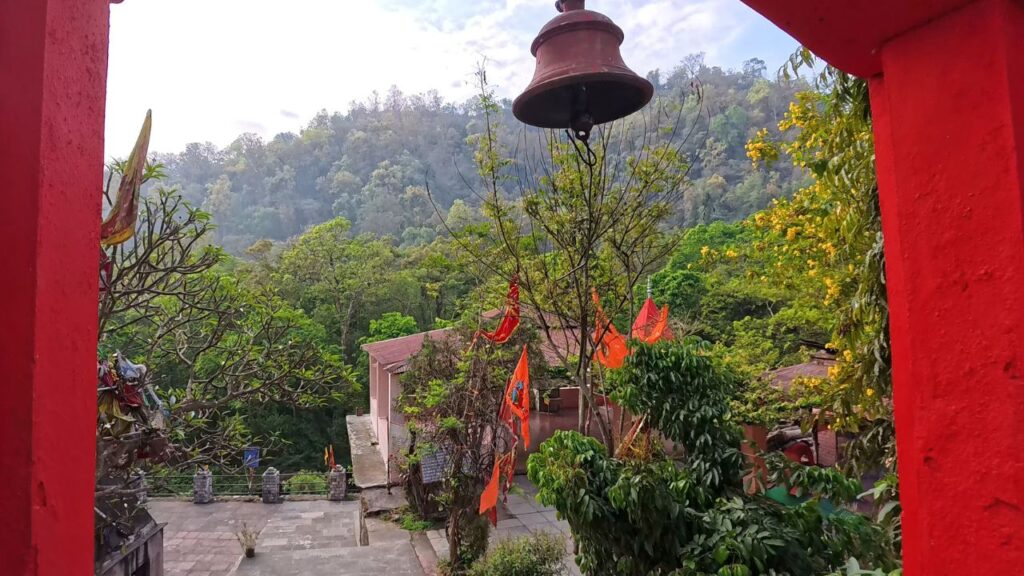
Into a valley. Small, contained, completely hidden from the forest floor above it. And as the valley opened up below us—temple. Multiple structures. Orange paint. Stone. Water flowing. A priest. The sound of water.
Sitabani Temple is the kind of place that travel writing usually reaches for the word “magical” to describe. I’m going to try to be more specific than that.
Sitabani Temple: The Name Carries the Whole Story
Before anything else—the name.
Sitabani. Two words fused into one. Sita. Bani—or more precisely, ban—which in Hindi means “forest.”
Sita’s forest.
This is not a poetic description applied after the fact. This is the name the place has carried for millennia because of what is said to have happened here. During the vanvaas—the years of forest exile that Lord Ram, Maa Sita, and Lakshman undertook—this forest was among the places they passed through and stayed. Maa Sita, in this forest, worshipped Lord Shiva. The form of Shiva she prayed to became known as Siteshwar Mahadev—Siteshwar meaning Sita’s Ishwar, Sita’s Lord.
And it is said that here, in this forest, in this valley, Luv and Kush were born.
I want to let that sit for a moment before continuing.
The forest you are driving through on your Jim Corbett safari—the same forest where tigers leave pug marks on the road, where spotted deer move through the undergrowth, where hornbills land on branches near the jeep—this forest carries a story that is thousands of years old. The jungle is not a backdrop. It is the story itself.
The Sitabani zone is named after this temple. The safari zone is named after a goddess. Most people who book the safari don’t know this. They drive through Sita’s forest looking for tigers, and the forest holds both things simultaneously—the wild and the sacred—without any contradiction.
The Descent Into the Valley
The approach is part of the experience. I want to describe it carefully because it’s unlike any temple approach I’ve encountered.
You are walking on flat jungle ground—trees, undergrowth, the normal visual texture of a forest. Nothing prepares you. And then the ground breaks, and steps appear, carved stone going downward, and below them a valley that wasn’t visible a moment before.
This is the genius of the site, intentional or natural. Sitabani Temple sits in a small, contained valley—low enough that it’s hidden from the forest floor, visible only when you’re already at its edge. There’s no announcing it from a distance. No dome visible above the treeline. No signage pointing dramatically toward it.
You simply arrive at the rim of the valley and look down, and there it is.
That moment of seeing it—the orange of the main temple against the green of the valley floor, the water catching light, the whole contained world of it—is a specific feeling. Not the feeling of arriving at a planned destination. The feeling of finding something.
What You Find in the Valley
The complex at Sitabani Temple is not one structure. It is several, arranged in a space that feels exactly large enough for what it contains—not crowded, not sprawling.
The Main Temple—Ram, Lakshman, Sita and Hanuman
The central and most prominent structure houses the four together—Ram, Lakshman, Maa Sita, and Hanuman. The temple has been renovated, its exterior painted a warm orange that catches the light that filters into the valley. This is not the ancient-stone darkness of an undisturbed medieval temple. It has been maintained, cared for, and repainted. The people who tend to this place take seriously the responsibility of keeping it.
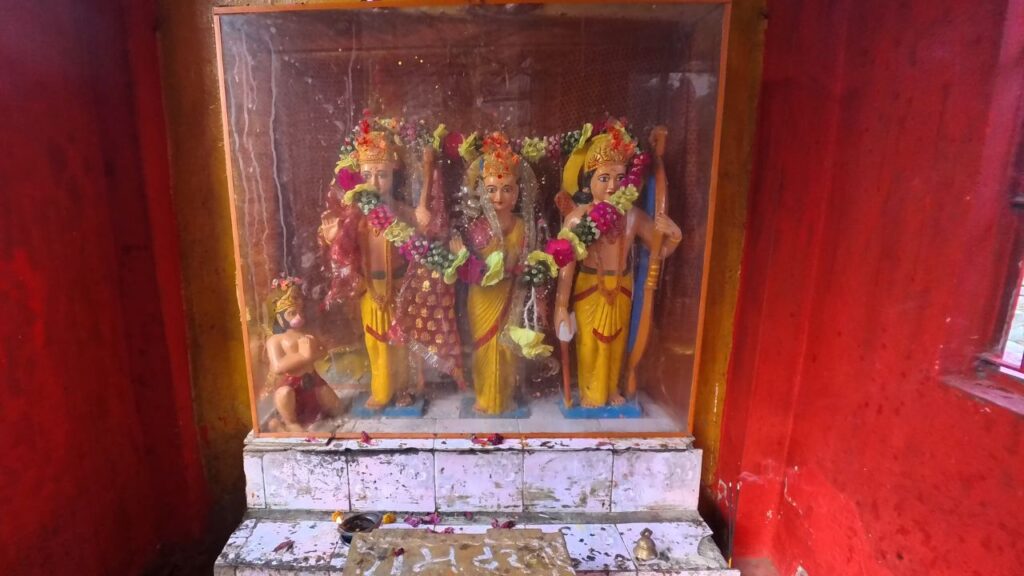
Inside, the four figures together tell the story that this entire forest carries. Ram and Sita, in the forest of their exile. Lakshman, who chose exile alongside his brother. Hanuman—the devotee, the protector, the one who carried their story across oceans and centuries. Here, in the jungle where they are said to have walked, they stand together.
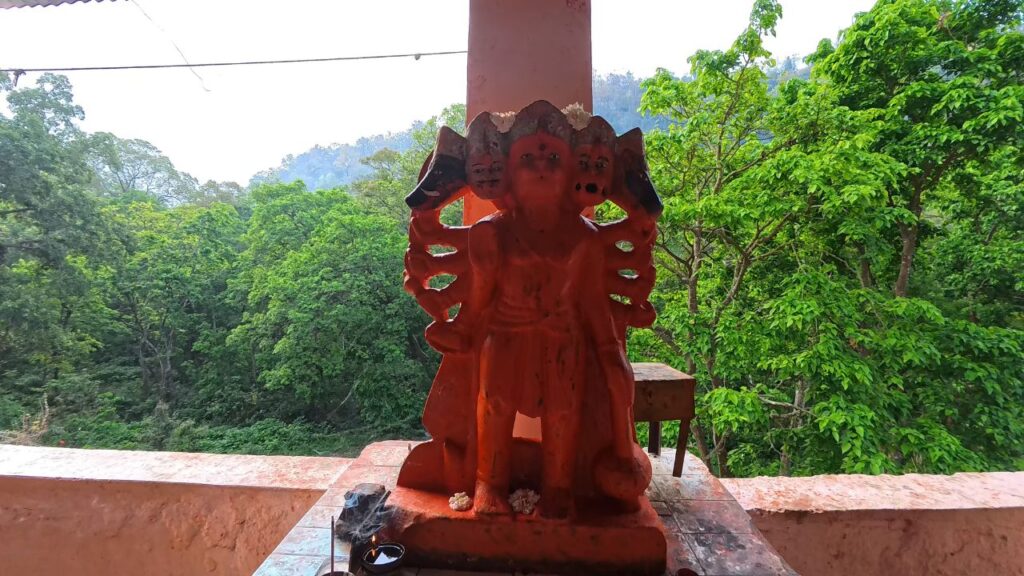
The Three Shiva Temples
Surrounding the main temple are three smaller stone structures—older in feeling than the main temple, rougher in construction, the kind of small shrines that have been present in forest clearings for as long as people have felt the need to mark sacred ground.
Each is dedicated to Lord Shiva. The primary one is Siteshwar Mahadev—the form of Shiva that Maa Sita worshipped here. To stand at a Shiva temple in a forest where Sita prayed, with that specific name — Siteshwar — inscribed above the entrance, is to feel the weight of accumulated devotion across time in a way that a newer, larger temple doesn’t quite replicate.
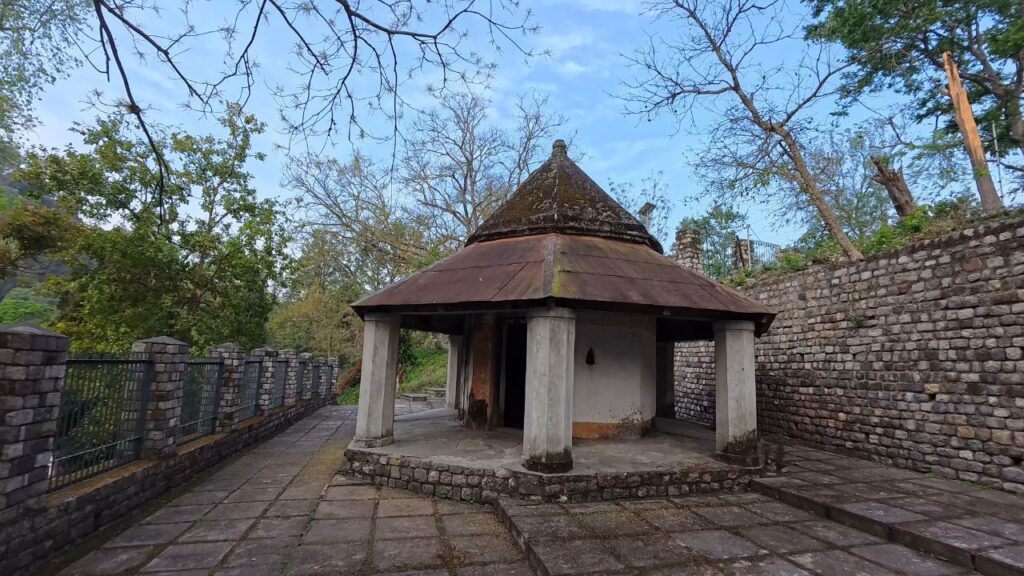
There is also a temple to a goddess and one dedicated to a saint within the complex. The saint’s temple adds a more recent layer of human presence to an already layered site—someone who came here, perhaps drawn by the same pull that draws visitors today, and stayed.
The Three Water Flows
This is what makes Sitabani Temple physically unlike anything else in the Corbett region.
Three separate streams flow down from the valley walls, each finding its own path through the stone, converging at the base to form a small natural lake. The sound of this—three simultaneous water sounds, distinct but harmonizing—fills the valley continuously.
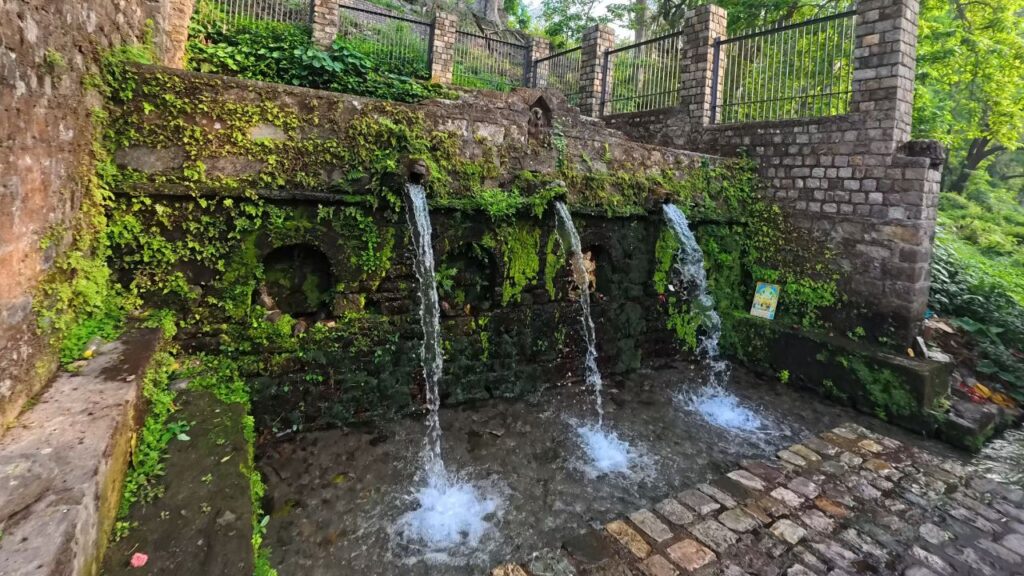
Water at a sacred site is never incidental in the Hindu tradition. The combination of forest, temple, and flowing water is a specific combination that the tradition identifies as deeply auspicious. The confluence of streams at the base of the valley where these temples stand is not just scenery. It is part of what makes this place what it is.
Standing at the edge of the small lake, with the temples behind you and the forest above, the water sounds around you—it’s quiet in a particular way. Not silent. Filled with water. Which is a different kind of quiet from silence.
The Priest Who Stays
There is a priest who lives here.
Not visits. Stays. The Sitabani Temple has a resident priest—a human being who has chosen this valley in this forest as the place to spend his days. No city, no road noise, no quick access to anything urban. Just the forest, the temples, the water, and the steady practice of keeping the sacred space alive.
I didn’t have enough time to talk to him properly—the jeep driver was signaling that we needed to move—but his presence registered deeply. There are places in India where the physical structure is maintained but the spiritual attention is absent. Sitabani Temple is not one of those places. Someone is here. Someone tends the lamps, performs the puja, and keeps the water channels clear.
That continuity of human presence in a forest that could easily feel abandoned—it changes the quality of what you find when you arrive.
Fifteen Minutes That Weren’t Enough
We had fifteen minutes.
The jeep driver had been patient through the walk-in, the descent, and the time at the temples, but safaris run on schedules, and we were nearing the end of ours. Fifteen minutes, and then we had to go back.
I want to be honest: fifteen minutes at Sitabani Temple is not enough. We all felt it. Not the mild disappointment of a tourist who wanted more photos—something more specific. The feeling of having arrived at a place that warranted more time than was available. The kind of place where you’d want to sit at the edge of the small lake for twenty minutes doing nothing, or walk slowly between the three Shiva temples more than once, or simply stay in the valley and let the water sounds do what they do.
If you are planning a Sitabani zone safari and you know about this temple, tell your guide at the start. Ask for time at the temple. Most drivers and guides will accommodate if asked upfront. The fifteen minutes we had came from the temple appearing as an afterthought. Build it into the plan and you’ll get more.
Why Forest Temples Feel Different
I’ve visited temples across India—ancient cave temples carved into cliffs, elaborate South Indian complexes with towering gopurams, small hill shrines reached by long climbs, and riverside ghats where the boundary between temple and river dissolves. Each type has its quality.
Forest temples are different in a specific way that I keep returning to.
In a city temple, the sacred space is carved out of the human world. Walls are built, noise is somewhat reduced, and the architectural intention is to create a container for devotion within an environment that is fundamentally not about devotion.
In a forest temple, the sacred space is already inside something that isn’t human at all. The forest doesn’t care about the temple—it continues being itself, growing, moving, and making its sounds, regardless. And yet the temple is here, held by the forest, maintained by a priest who chose this, visited by people who walk down into a valley they couldn’t see coming.
There’s a humility to a forest temple that larger, more accessible temples can lose over time. It asks something of you just to reach it. It offers nothing convenient. And what it gives in return is a quality of encounter that the convenient places can’t quite match.
Sitabani Temple asks you to get into a jeep, drive into a buffer zone, walk through the jungle, and climb down steps into a hidden valley. That asking is not an obstacle. It is, I think, the point.
The Sacred Geography of Corbett
By the end of our Jim Corbett trip, I had a different understanding of the region than I’d arrived with.
I’d known about the national park. The tiger. The safari zones and permits. That’s what most people know.
What the trip gave me was a different picture—a region layered with devotional geography that most travel writing ignores completely. The Koshi river is holding the Garjiya Devi temple on a boulder in the middle of the water. Hanuman Dham, newly opened, carrying five distinct forms of Hanuman in one complex. And here—Sitabani Temple, at the end of a safari, at the bottom of a valley, where a priest lives and three streams meet and Maa Sita is said to have prayed.
These are not separate dots. They are connected by the same geography, the same ancient understanding that this forest region is not just wildlife habitat. It is a landscape that has been sacred for thousands of years, through multiple traditions, across multiple stories.
The tiger is why most people come to Jim Corbett. The sacred geography is what the place actually is.
Practical Notes
Access: Sitabani Temple is inside the Sitabani buffer zone—accessible only via safari. You cannot walk or drive there independently. Book a Sitabani zone safari through your resort or a local operator and tell the guide you specifically want to visit the temple.
Time: Ask for at least 30 minutes at the temple when booking. Our fifteen minutes was too short. Most guides will accommodate if asked in advance rather than at the gate.
The approach: a short walk from where the jeep stops, then stone steps descending into the valley. No difficulty, but wear proper footwear—the stone steps can be uneven.
Signboards: Information boards are present at the temple. Worth reading—they give the mythological context in detail that deepens the visit.
The water: Three streams converge into a small lake within the complex. The water is clear. Treat the space with the reverence appropriate to an active place of worship.
Other visitors: There will typically be some. The temple is not completely unknown. But the effort required to reach it keeps the numbers naturally low—you will not find crowds here.
Photography: Use your judgment and consult the priest. Many forest temples permit photography outside the inner sanctum.
Climbing Back Up
The steps going back up out of the valley are steeper than going down.
Which is usually how it works with places worth visiting.
At the top, back on the flat jungle floor, I turned once and looked back. The valley was already invisible—the temple, the water, the orange paint, the priest, the three streams—all of it simply gone from view. The forest floor gave nothing away.
A few hundred meters away, a tiger had left pug marks on this road an hour earlier. Two thousand years ago, by the tradition this place carries, a goddess walked through this forest and prayed in the valley below.
The jungle holds both of these things without effort.
I walked back to the jeep thinking about that.