
He was coming down as we were going up.
Tired expression. Quick walk. The body language of someone who had already made a decision and was moving past it. We stopped him and asked—how is it? Worth going?
He didn’t hesitate. “Worst place. Mat jaao. It is a complete waste of time.”
We thanked him. He walked on. We looked at each other for a moment.
And then we went anyway.
This post is about what we found when we did.
How We Even Ended Up at Barati Rau Waterfall
Day 2 in Jim Corbett had already been a full one. Hanuman Dham in the morning — a newly built temple complex that was more impressive than we’d expected. Corbett Falls after that, which was beautiful but crowded enough that we spent exactly as long as it takes to appreciate something and decide you’d rather appreciate it without forty other people in the frame. Then the Jim Corbett Museum, which I genuinely recommend if you have any interest in the man whose name this forest carries. Lunch at a jungle-themed restaurant that was more fun than it had any right to be.
On the drive back to the resort, someone said, “There’s a waterfall nearby. Barati Rau Waterfall. Should we go?”
This is the kind of decision that defines a trip. You’re tired. You’ve already done three things. The resort is twenty minutes away, and the bed is a known quantity. The waterfall is an unknown.
We went.
And that is how we found ourselves on the road toward Barati Rau waterfall, Jim Corbett’s most underestimated spot, just as the afternoon was softening and a stranger was trying to talk us out of it.
What Barati Rau Waterfall Actually Is
Before the story continues, a note on the place itself, because I had almost no information about it before we went, and I think that’s part of why the experience hit differently.
The Barati Rau waterfall is located in the Pawalgarh Conservation Reserve, a forested area adjacent to Jim Corbett National Park near Ramnagar. It sits about 5 kilometers from the more famous Corbett Falls, in the village of Chunakhan. Most Jim Corbett itineraries mention Corbett Falls and leave Barati Rau Waterfall as a footnote, if they mention it at all.
The approach involves a short jungle trek — nothing demanding, no special fitness required. The path runs alongside a stream for much of the way, through shade-heavy forest. Entry is nominal—₹50 per person; the counter opens at 8:30 AM.
That’s the factual version. The experiential version takes longer to tell.
The Walk Begins — And Something Immediately Changes
The parking area is straightforward. Pay the entry fee and start walking. The path goes uphill—gently at first, then more noticeably, but never steeply enough to be a challenge.
What you notice within the first two minutes is the temperature.
It drops. Noticeably. Not gradually—there’s an actual moment where the air around you shifts, cooler and wetter, and you realize it’s because there’s a stream running right alongside the path. Small, clear, moving steadily downhill as you move up. The sound of it is constant — not loud, just present. Like background music that you stop noticing after a while but would immediately miss if it stopped.
The path here is paved—not the urban, maintained kind, but village-road paved, irregular, and real. The stream crosses it at points. You step over it or through it on the flatter stones. Occasionally you’re walking on one bank and then, without ceremony, on the other.
The forest closes in as you climb. Trees overhead. Dappled light. That specific temperature that forests maintain even when the surrounding countryside is hot. We’d been in full afternoon sun all day—temples, falls, and restaurants—and this sudden shade felt like being let into a cooler room.
I heard someone behind me say, “Yaar, acha lag raha hai.” Nobody disagreed.
At this point I had already decided the stranger was wrong. The walk alone was worth the stop. Whatever the waterfall turned out to be, we were already winning.
The First Viewpoint — And Why Most People Turn Back Here
About ten minutes in, the path opens to a viewpoint.
Below—a small river valley. Across the valley is a waterfall.
Very small. Thin. There is a white line on the distant rock.
I will be honest: in that moment, I thought the stranger might have been right.
It was not impressive. From that distance, in that light, the waterfall was fine. Present. Nothing that justified the climb or the entry fee or the expectation. I could see why someone would stand at this viewpoint, take a photo, say “theek hai,” and start back down.
But there was also a path continuing ahead.
And this is the part that I think separates the people who have a great experience at Barati Rau waterfall from the people who don’t: the willingness to treat the first viewpoint as a comma, not a full stop.
The path kept going. The stream was still alongside us. The forest was getting denser, not thinner, which in my experience usually means something is ahead, not behind. We kept walking.
What Ten More Minutes Buys You
The second stretch of the path is where Barati Rau Waterfall reveals itself properly.
The paved section ends. You’re on a forest trail now—compacted earth, tree roots, and the stream sometimes right at your feet. The canopy is thicker here. The light comes through in specific shafts rather than generally. The temperature drops another degree or two.
And then, the sound.
Water, but louder. Moving differently from the stream. A different register.
The path curves around a rock formation, and the waterfall is in front of you.
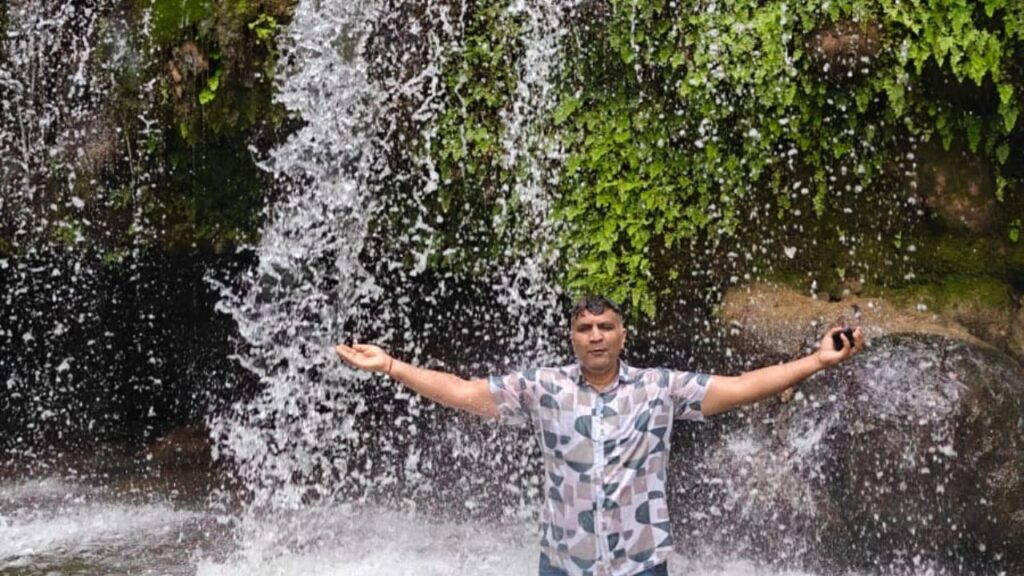
Not the distant white line from the viewpoint. The actual Barati Rau waterfall, close enough to feel its spray—water falling from a height of rock into a natural pool at the base, ringed by boulders and thick jungle on all sides. The rock face around it is green with moss and fern. The pool is clear—cold-looking, still-looking, the kind of water that makes an immediate promise to your body temperature.
Nobody said anything for a few seconds.
Then someone said, quite quietly, “Woh banda galat tha.”
He was. Completely.
The Hydro Massage You Didn’t Plan For
We were in the pool before we’d consciously decided to get in.
Cold — immediately, seriously cold. The kind that makes you inhale sharply and then exhale slowly as your body recalibrates. The bottom was rocky but smooth. The pool was shallow enough to stand in comfortably.
And then the waterfall itself.
Someone stepped under it first. The rest of us watched for exactly three seconds before following.
The pressure of the water from above is not aggressive—it’s not a showerhead, and it’s not a plunge pool. It’s the weight of moving water falling from a height, landing on your shoulders and head and back with a consistent, rhythmic force that is, without question, the best massage I have had in recent memory. Better than the spa at the five-star hotel I stayed in last year. Better than the physio. Better than anything that cost money and happened in a room.
We stood under the Barati Rau waterfall, in the middle of a Jim Corbett jungle, getting rained on from above, laughing like people who have just discovered something that was hiding in plain sight.
Clothes wet. Completely. Beyond the point of trying to manage it.
It didn’t matter.
On the Way Down — Discussing the Stranger
The walk back down takes half the time the climb did. The stream is now on the other side. The forest looks different going down — the light has shifted slightly, the late afternoon coming in at a different angle.
We talked about the man on the way down.
The consensus was that he had turned back at the viewpoint. Seen the distant waterfall. Made a decision. And then, carrying that decision, he told us with complete confidence that the place was a waste of time.
He wasn’t lying. He genuinely believed it. He just hadn’t seen the whole thing.
This happens constantly in travel. Someone visits a place partially and reports back on the full experience. Someone goes at the wrong time, misses the thing that makes the thing worth going for, and then their opinion travels faster than the actual information. “Don’t go there” spreads faster than “go there, but keep walking past the first viewpoint.”
I’ve thought about this since—not just about the Barati Rau waterfall, but as a general principle. How much of what we decide not to do is based on someone else’s incomplete experience? How many places have we not visited, things we haven’t tried, and decisions we haven’t made—because someone who didn’t see it through gave us a confident summary of what we’d find?
The waterfall was twenty minutes from the viewpoint. The man turned back before twenty minutes. That’s the entire story.
Why Barati Rau Deserves More Attention Than It Gets
I want to make a specific case here, because I think the way this waterfall is covered online does a disservice to it.
Most content about Barati Rau waterfall describes it in the same terms: “hidden gem,” “peaceful,” “serene,” and “off the beaten path.” All of those things are true. But they’re also the phrases that get applied to every second waterfall in India, and they don’t actually tell you what makes this one specific and worth your time.
Here is what makes Barati Rau specific:
The walk is half the experience. The stream path, the forest, the temperature drop — none of that shows up adequately in a list of bullet points. This is not a waterfall you drive to and photograph. It’s a waterfall you arrive at.
The pool is real. Not a wading pool, not a photo-opportunity pool. An actual natural pool deep enough to stand in, cold enough to matter, with the waterfall feeding into it directly. You can get in. You should get in.
The crowds — or lack of them. We saw almost nobody on the trail. Coming down, we passed two other groups going up. At the waterfall itself, we had it to ourselves for twenty minutes before anyone else arrived. In a region that gets significant tourist footfall, that level of solitude is genuinely rare.
The forest itself is Jim Corbett-adjacent. You are in the Pawalgarh Conservation Reserve—a protected forest and genuine wildlife habitat. The sounds you hear are not background noise; they’re the forest being itself.
The Practical Guide—For Those Who Want to Go
Everything above is the story. Below is the information.
Location: Barati Rau waterfall is in Chunakhan village, near Kaladhungi, approximately 5 km from Corbett Falls. Search “Barati Rau Waterfall” on Google Maps — it is on the map, though some reviews note the pin is slightly inaccurate. Ask locally if you’re unsure.
Entry fee: ₹50 per person. The counter opens at 8:30 AM. No photography charges that we encountered.
The trek: About 1 km, roughly 20–25 minutes at a comfortable pace. The first section is paved and easy. The second section, past the viewpoint, is a forest trail—stable footing, no technical difficulty, but proper footwear helps. Flip flops are a bad idea.
The non-negotiable: Do not turn back at the first viewpoint. This cannot be stressed enough. The distant waterfall you see from there is not the destination. Keep walking for ten more minutes. The actual waterfall is around the bend, closer, louder, and completely different in scale and experience.
Carry a change of clothes, or clothes you don’t mind getting wet. A small towel. Water for the trail. Snacks if you’re going as part of a longer day—there are no food stalls at the waterfall itself.
Best time to visit: October to February for comfortable temperatures. Avoid monsoon season (July–September)—water levels rise significantly, and the trail can be slippery. Early morning, before 11 AM, if you want the forest at its quietest.
Timing within your Jim Corbett day: We did it as a late-afternoon stop, and the light was beautiful for it. But morning works equally well. Build 1.5 to 2 hours into your plan—that covers the drive in, the trek up, time at the waterfall, and the walk back. Don’t rush this one.
The viewpoint decision: If you reach the first viewpoint and the waterfall looks unimpressive, that is correct. You are looking at it from far away. The path continues. Use it.
What the Stranger Taught Us Without Meaning To
We reached the resort later than planned. Wet, tired, and significantly happier than we would have been if we’d taken the advice on the way up.
That evening I thought about the man coming down the trail. His confidence. His complete certainty that he had assessed the place correctly and was doing us a favor by sharing that assessment.
He wasn’t malicious. He was helpful, in his own way. He’d just stopped too soon.
The lesson isn’t “ignore everyone’s advice.” Most travel advice is useful and saves you time. The lesson is more specific: when someone tells you a place isn’t worth it, find out how far they actually went. Ask what they saw. Ask if they kept walking.
Because sometimes the only difference between a wasted afternoon and one of the best thirty minutes of a trip is ten more minutes on a forest path, and the willingness to trust that the stream running alongside you is going somewhere worth following.