
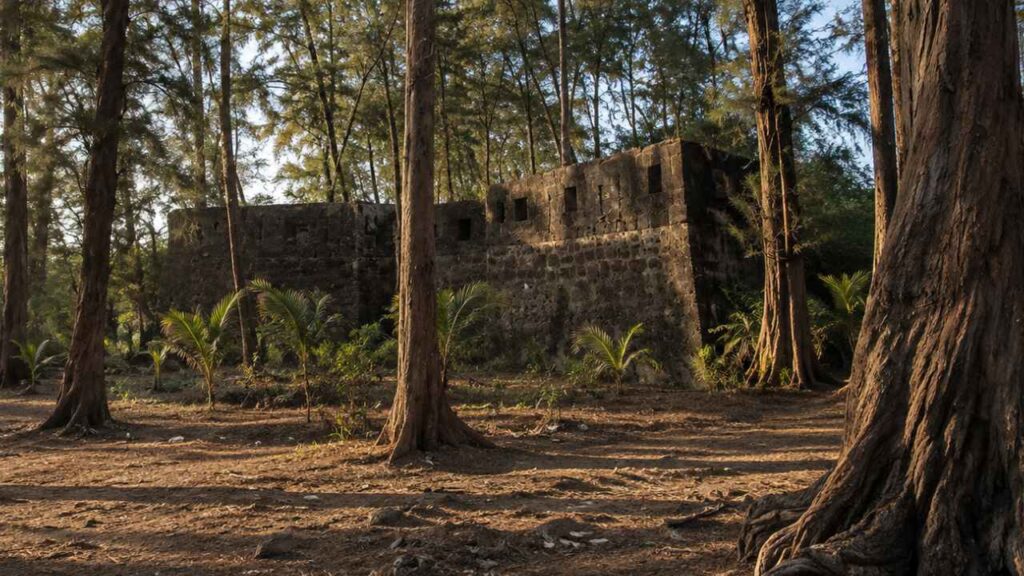
Kelve beach is easier to find than the fort.
Kelva opens out in a long sweep of sand, sea, and tall Suru trees. The coast looks peaceful, almost deliberately untouched, and nothing in the first few minutes suggests that a military structure is hidden nearby. There is no imposing gateway waiting at the end of the road, no high wall announcing the entrance, and no monument rising above the plantation.
You have to look for it.
In the book, I describe the approach to Kelve Fort as a gradual discovery. The trees conceal more than they reveal. A broken line of masonry appears through the vegetation, then a low wall, and then a fragment that seems too deliberate to be natural. Only after looking carefully do you realize that the beach is holding the remains of a Portuguese coastal fort.
Kelve Fort does not dominate its surroundings. It has been absorbed by the landscape.
Sand, roots, shrubs, and years of neglect have softened its outline. Parts of the fort are difficult to distinguish from the landscape, while other sections have disappeared beneath vegetation and coastal growth. What survives is modest, but the location tells us why the fort mattered. It stood near the coast, beside the waterways and beaches that formed part of the Portuguese defense network in the north Konkan.
The fort was built in the 16th century, when the Portuguese were establishing a chain of coastal positions connected to their larger stronghold at Vasai. Kelve was not intended to rival Vasai in size. Its purpose was more practical: to watch the shore, monitor movement, protect nearby settlements, and support the wider system of forts that guarded Portuguese interests along the coast.
Today, the fort feels almost too quiet for its history.
The guns are gone. The garrison has vanished. The walls have been reduced to fragments, and the trees have taken back much of the ground. Yet standing among the ruins, you begin to imagine the coastline as it once was—a watched frontier of boats, creeks, soldiers, traders, and rival empires.
Kelve Fort at a glance
- Location: Mangelwada, Kelve village, Palghar district, Maharashtra.
- Setting: Near the southern end of Kelva Beach, among Suru or Casuarina trees.
- Type: Small Portuguese coastal fortification and watch post.
- Historic role: To guard coastal movement, nearby settlements, and the broader north Konkan maritime route.
- Built by: Portuguese, generally associated with the 16th century.
- Maratha capture: 1739, during Chimaji Appa’s campaign against Portuguese coastal possessions.
- British control: After 1818.
- Present condition: Mostly ruined, overgrown, and partly covered by sand and plantation growth.
- Access: Accessible year round from the Kelva Beach and village side.
- Important distinction: Kelve Fort is separate from Kelva Pankot, also referred to locally as Alibaug Fort, which lies off the beach and has a tide-dependent approach.
Where is Kelve Fort?
Kelve Fort is located in Kelve village in Palghar district, Maharashtra. It is close to Kelva Beach, also spelled Kelwe or Kelva Beach, and is generally associated with the Mangelwada area.
The fort stands amid the coastal vegetation near the beach, rather than out in the sea. This is an important point because several nearby fortifications are often confused with each other.
Kelve Fort is the small, land-accessible, heavily ruined fort near Kelva Beach. It can be visited throughout the year, subject to local access and weather conditions.
A separate structure known as Kelva Pankot, and referred to in your book as Alibaug Fort, lies near the mouth of the creek off Kelva Beach. That is the fort associated with tide-dependent access, a movable-ladder history, and separate entrances for high and low tide.
The two sites belong to the same broad coastal defense landscape, but they are not the same fort.
A small fort hidden in the Suru trees
At first glance, Kelve Fort does not appear to be a fort at all.
The Casuarina plantation and other vegetation have grown so thickly around it that much of the structure blends into the landscape. Over time, sand has reportedly buried parts of the fort, while plants, shrubs, and trees have hidden other sections.
The fort’s present condition is deeply dilapidated. You are unlikely to encounter intact rooms, dramatic archways, or well-preserved interiors. Instead, the remains appear in fragments.
A broken wall. A low parapet. A small section of masonry. An overgrown stretch that may once have been part of the fort’s defensive line.
That is precisely what makes the site interesting. The fort does not present itself all at once. It asks you to look carefully.
In its present state, Kelve Fort is less a monument and more a reminder of how history can disappear quietly into the landscape.
The Kelve-Mahim coastal defense network
Kelve Fort should not be understood in isolation.
The coast around Kelva, Mahim, Shirgaon, Tarapur, and Dahanu was once dotted with small forts, batteries, stockades, and observation points. Some were substantial enough to hold garrisons and guns. Others were little more than watch posts or artillery positions.
Together, they created a defensive system.
The Portuguese needed these coastal points to protect trade, monitor ships, guard creeks, and maintain communication along their north Konkan territories. Their major center in the region was Vasai, then known as Bassein, but it depended on smaller defensive positions spread across the coast.
Kelve Fort was one of these smaller positions. Its location close to Kelva Beach and the surrounding creek system gave it a useful view of the coast. It could help monitor local movement and support nearby forts if required.
The fort may not have carried the political importance of Vasai or the larger military role of Tarapur, but it still formed part of the same story.
Portuguese Kelve Fort
The Portuguese expanded their influence along this section of the coast in the 16th century. Kelve Fort is generally described as a Portuguese construction from that period.
The fort was built during a time when maritime power depended on more than ships. It required safe ports, coastal storage, fortified settlements, freshwater sources, artillery positions, and smaller stations that could warn larger centers about approaching threats.
Kelve was useful because it sat beside a beach and close to the creeks that connected the coast with the hinterland. The Portuguese could use the fort to watch over local traffic and protect their interests in the region.
The fort is often described as a coastal watch post or naval observation point. This is a more realistic way to understand it than calling it a large military stronghold.
Its role was likely surveillance, support, and local defense.
Guns and Garrison at Kelve
Today Kelve Fort is small, but history has it that the fort had a working garrison and artillery.
The book records that the Portuguese maintained a garrison of 60 soldiers at Mahim, along with 15 pieces of ordnance and a supporting stockade. This gives an idea of how seriously the Portuguese took their defenses across the Kelve-Mahim region.
Some sources specifically associated with Kelve Fort refer to a 1727 garrison of 60 men, including seven Europeans, and 15 guns, many of which were reportedly not in serviceable condition. The exact details should be treated cautiously because available modern sources are limited and sometimes repeat one another without citing the original record. Still, they support the broader picture of Kelve as a manned Portuguese outpost rather than simply an abandoned wall on the beach.
It is easy to forget this when standing among the overgrowth today.
The same ground that now holds shrubs and trees once needed to accommodate men, provisions, ammunition, and guns. The fort’s low profile would have been practical for observing the shore and defending a small coastal position.
Chimaji Appa and the Maratha capture
The decisive change in Kelve Fort’s history came in 1739.
By then, Chimaji Appa was leading the Maratha campaign to remove Portuguese control from the north Konkan coast. The campaign was not focused on one famous fort alone. It involved a systematic effort to capture Portuguese positions and cut off their control over the coast.
Mahim, Kelve, Shirgaon, Tarapur, and other coastal positions became part of this campaign. The book records that Kelve Fort was conquered in 1739 and incorporated into the Maratha kingdom.
Some secondary sources place the capture of Kelve and Shirgaon around 10 January 1739, in the period when the Portuguese defensive line was being steadily weakened before the final fall of Vasai later that year.
The capture of Kelve Fort may not have involved the dramatic battle narratives associated with Tarapur or Vasai. But its fall still mattered. Each smaller fort taken by the Marathas reduced Portuguese control over the coast and weakened their ability to move supplies, gather intelligence, and reinforce larger strongholds.
The campaign showed the value of a network. When the smaller links began to fall, the larger Portuguese system became increasingly vulnerable.
Kelve Fort under the British
After the Maratha period, Kelve Fort eventually passed into British hands along with many other forts in Maharashtra after 1818.
By then, the fort had lost much of its earlier military value. British control over the coast, changing military technologies, and the declining strategic importance of small coastal outposts meant that many such forts were no longer actively maintained.
Kelve Fort gradually fell into neglect.
Without a garrison, regular repairs, or a strong administrative use, the fort began to disappear into its surroundings. Sand, vegetation, coastal weather, and time did what they do to many small forts: they slowly absorbed the structure.
Today, its ruined state is a reminder that not every fort becomes a protected monument or a major tourist destination.
What remains at Kelve Fort today?
Kelve Fort is in ruins.
The surviving remains are limited and may be difficult to identify at first. The book describes Kelve as a series of small fortifications, while modern references describe it as a small, partly buried coastal fort near the beach.
The fort once had defensive walls and bastions, but most of the interior structures have vanished. The area is now dominated by vegetation and plantation growth.
When you visit, you may find:
- Fragments of old walls.
- Low parapet sections.
- Overgrown bastion remains.
- Broken brickwork.
- Sand buries parts of the old fort.
- Coastal vegetation and Suru trees growing around the ruins.
- A sense of the old shoreline and its defensive importance.
Do not expect a fully intact fort. Kelve Fort is better approached as a heritage fragment.
The appeal lies in imagining what is no longer visible.
The reported unearthing of the fort
Some local historical references state that Kelve Fort, which had been buried under beach sand and vegetation, was unearthed around 2008–09.
This detail fits the experience of the fort today. Its remains appear partially reclaimed from the landscape, yet not fully restored or interpreted for visitors.
The coastal environment is unforgiving. Wind blows sand, roots force their way through masonry, rain wears away exposed stone, and salt air accelerates decay. A small fort that has not been continuously maintained can disappear quickly.
The reported unearthing is significant because it suggests that more of Kelve’s story may still lie beneath the sand and growth. It also reinforces the need to treat the site with care. These are fragile ruins, not robust structures designed for modern visitor traffic.
Kelve Fort and Kelva Pankot are different forts.
This distinction deserves a separate section because it is the source of repeated confusion online.
Kelve Fort is the ruined, land-accessible fort near Kelva Beach, hidden among plantation growth and accessible year round.
Kelva Pankot, also known locally by some as Alibaug Fort, is a separate small fortification located near the mouth of the creek off Kelva Beach. It is the site whose approach is affected by tides.
The book describes the Alibaug Fort as a small irregular pentagonal battery with five cannon openings. It had two entrances, one used at high tide and the other at low tide. A nearby coastal battery called Panburuj added another layer of defense.
Those features do not belong to Kelve Fort.
Keeping the two posts separate will be useful for readers because the sites offer different experiences:
- Kelve Fort is an overgrown, quiet, land-based ruin.
- Kelva Pankot, or Alibaug Fort, is a separate creek-mouth outpost with tide-related access and a very different layout.
Kelva Beach and the setting around the fort
Kelva Beach is one of the most peaceful stretches of coastline in Palghar district. It is known for its long sandy shore, Casuarina trees, and more relaxed atmosphere than many of the busier beaches closer to Mumbai.
The beach is the reason Kelve Fort works as a travel stop.
The fort alone will not take long to explore. But combine it with a walk through the Suru trees, time on the beach, and nearby heritage sites, and the visit becomes far more rewarding.
The plantation gives the beach a distinctive feel. Tall Casuarina trees in long lines give shade and a natural corridor between the road, settlement, and sea.
Around Kelve Fort the landscape is quiet. Its condition may be neglected, but the setting remains beautiful.
How to reach Kelve Fort
By rail: The nearest practical railway station is Palghar. From Palghar, you can take a local bus, shared auto-rickshaw, taxi, or private vehicle towards Kelva Beach and Mangelwada.
By road: Kelva is accessible by road from Palghar, Mahim, Shirgaon, and other north Konkan coastal towns. If travelling from Mumbai, drive north towards Palghar and then take the local road towards Kelva Beach.
The fort lies close to the beach and village side. Ask locally for directions to Kelve Fort or the old fort near Mangelwada, as small heritage sites are not always prominently marked.
By air: Mumbai is the nearest major airport. From Mumbai, continue by rail or road to Palghar and then towards Kelva.
Best time to visit Kelve Fort
Kelve Fort is accessible through the year, but the most comfortable time to visit is between October and March.
The weather is kinder for beach walks, the Suru plantation feels pleasant, and you can spend time exploring the fort ruins without the harsh summer sun.
The monsoon has its own charm. The coast becomes lush and dramatic, and the plantation turns intensely green. But the ruins may be slippery, the vegetation denser, and the ground around the fort wetter. Avoid climbing walls or entering unstable sections during this season.
Early morning and late afternoon are ideal. The beach is quieter, the light is better for photographs, and you can enjoy the fort and shoreline without rushing.
Unlike Kelva Pankot, your Kelve Fort visit does not need to be planned around the tide.
What to see near Kelve Fort
Kelve Fort is best visited as part of a wider north Konkan coastal circuit.
- Kelva Beach: Spend time walking the shore and the Casuarina-lined stretch near the fort.
- Mahim Fort: A small creekside fort in the nearby Kelve-Mahim coastal network.
- Shirgaon Fort: A better-preserved coastal watchtower farther north, with substantial walls and beach views.
- Tarapur Fort: A larger Portuguese fort with a stronger documented military and trade history.
- Alibaug Fort / Kelva Pankot: A separate tide-dependent fortification near the creek mouth, to be covered separately in this series.
- Shitla Devi Temple: A nearby local landmark often included in the Kelva area itinerary.
- Palghar: The nearest transport base for exploring this stretch of coast.
Practical tips for visiting Kelve Fort
- Search for Kelve Fort near Kelva Beach, Palghar, to avoid confusion with Kelva Pankot or Alibaug Fort.
- Ask the locals for the way to the ruins now.
- Wear footwear appropriate to sand, rough ground, and vegetation.
- Carry drinking water and sun protection.
- Visit during daylight.
- Do not climb damaged walls or attempt to clear vegetation yourself.
- Be careful of loose stones, insects, snakes, and undergrowth.
- Keep the beach and the plantation clean.
- Respect the local community and private land near the site.
- Do not expect a restored monument. The fort is small and heavily dilapidated.
- If you are also planning to visit the separate Kelva Pankot or Alibaug Fort, check local conditions and tide timing for that site only.
Is Kelve Fort worth visiting?
Kelve Fort is worth visiting if you enjoy discovering lesser-known heritage sites.
It is not a grand fort. You will not find massive gateways, intact palaces, or a neatly restored interpretation center. Its walls are broken, its interiors have almost disappeared, and vegetation dominates much of the site.
But this is also its charm.
Kelve Fort tells the story of the smaller coastal positions that made larger empires possible. It was one watchpoint among many, helping the Portuguese observe and defend the north Konkan coast. It later became part of the Maratha campaign that transformed the political map of the region.
Visit it with the right expectations. Come for the beach, the trees, the quiet, and the curiosity of finding history hidden beneath the growth.
Final thoughts: history hidden in plain sight
Kelve Fort is proof that not all important forts look impressive today.
Its great past is buried in sand, in trees, in broken stone, and in neglect. But the location still speaks. The beach is still there. The coast is still open. The same Arabian Sea that once made this place strategically valuable still rolls in beyond the Suru trees.
The Portuguese built Kelve Fort as part of a coastal defense system. The Marathas captured it during their 1739 campaign. The British later inherited it, and time eventually reduced it to fragments.
Yet those fragments matter.
They remind us that history is not always behind gates and plaques. Sometimes it survives in a broken wall beside a quiet beach, waiting for someone to notice.
Save this post for your next north Konkan trip, share it with someone who loves hidden heritage, and follow the Sea Forts of India series as we continue along the coast.