
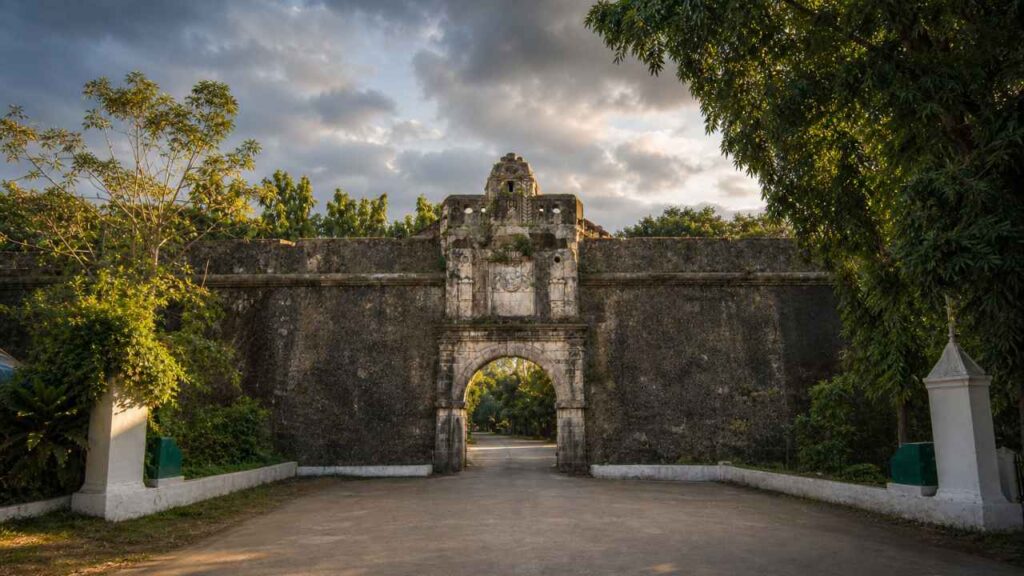
Standing on the south bank of the Damanganga River, Moti Daman Fort feels like a self-contained world of high stone walls, quiet lanes, churches, and sea breeze. As the sun drops over the Arabian Sea and the river reflects gold, the fort comes alive in a way that makes you slow down and look around.
The Moti Daman Fort and the Nani Daman Fort were historically located opposite each other on the river, providing a pair of defenses that enabled the Portuguese to control the movement from the sea into Daman. Today the fort is still the heart of the town, with many of the municipal and administrative offices still functioning within the fort as they were during the colonial era.
History of Moti Daman Fort
Gujarati rulers to Portuguese domination
Originally Daman was ruled by Gujarati monarchs, and before the Portuguese came, there was an ancient fort at this spot. In 1523, the Portuguese Captain-Major Diogo de Melo was blown off course by a storm while sailing towards Ormuz and, by chance, came onto the shores of Daman. Later on, in the decades that followed, they became increasingly interested in the port and started to lobby for trading privileges.
Portuguese invasions on Daman’s port became frequent from 1529 to 1559, and tensions with local rulers grew. Finally, in 1559, the Governor of Goa, Constantino de Bragança, commanded a strong fleet of over 100 ships and about 3,000 men to take Daman. He took the port and fort and assigned as Major to garrison it; Captain Diogo de Noronha began to rebuild the stronghold on a larger and stronger scale.
Constructing the new fort
The old fort was razed, and the new Moti Daman Fort started to be built. The fort’s gates carry inscriptions that say the southern gate and bastion were built about 1581 during an invasion attempt by the soldiers of Mughal emperor Akbar, and the northern gate and other parts were built later in the same period. It took over two decades of construction to make Daman a fortified Portuguese fortress.
Thereafter, Moti Daman Fort became the major Portuguese base in Daman, guarding the creek and the town. It was involved in area hostilities such as the Maratha campaign in Vasai in 1739, when Maratha troops surrounded Moti Daman to prevent Portuguese reinforcement of nearby forts.
End of Portuguese reign
Daman was a Portuguese territory for around 400 years, with Moti Daman Fort at the center of their population. In December 1961 Indian troops stormed Daman as part of Operation Vijay, which sought to overthrow Portuguese colonial rule over Goa, Daman, and Diu.
During the operation, Portuguese forces used buildings inside Moti Daman Fort as defensive positions but finally surrendered. The Moti Daman Fort is one of the few places in Daman that was absorbed into the Republic of India and yet bears the mark of that long colonial era in its construction and layout.
Moti Daman Fort in the present day
Fort walls, bastions and river vistas
Today, the Moti Daman Fort comprises sturdy walls of stone and bastions at regular intervals. Steps lead up to the ramparts of the fort and a ditch originally protected the walls from attack from land. Wide views of the Damanganga River and the other side of Nani Daman, the Arabian sea meeting the river at a distance, may be had from the walls and bastions.
Some bastions are flag posts and some parts of the fort open out to thoroughfares that run through and around the western perimeter. Many of the older structures have been damaged by time and occasional natural calamities, but they are still intact enough to give you a solid impression of the original fort layout.
Colonial structures and churches within
Moti Daman Fort Important buildings inside the fort are:
- The Se Cathedral, or Cathedral of Bom Jesus, is one of the oldest churches in Daman, which can accommodate hundreds of people at one time. A fine example of the Portuguese architecture of the period, its artwork and woodwork are a reflection of its colonial history.
- The Church of Our Lady of the Rosary is smaller but is known for its fine woodwork and neighboring tombstones, some of which are thought to belong to Portuguese martyrs. At least one tombstone is carved in wood and painted in gold.
- The interior has several government buildings and secretariat offices, a continuation of the fort’s heritage as an administrative headquarters.
Walk into the Moti Daman Fort today, and you will see calm streets, ancient houses, church squares, and official buildings living together to give the place a lived-in, small-town feel within historic walls.
How to get to Moti Daman Fort
By plane: The nearest major airport is Mumbai, around 180 km away from Daman, with daily flights from all over India. From Mumbai, you can drive to Moti Daman Fort or take a train and then a short road trip.
By Rail: The nearest railhead is Vapi, which is around 14 km from Daman. Vapi is on the major Mumbai-Ahmedabad line; hence, you get frequent trains from Mumbai and Gujarat. Hire a car, taxi or bus from Vapi to reach Moti Daman and walk into Moti Daman Fort.
By Road: Daman is around 14 km off NH8 and is easily accessible by road from Mumbai, Thane, and towns of Gujarat. After entering Daman, follow the signposts to Moti Daman and the fort area, and soon the river, churches, and towering walls make it evident you are in the historic section of town.
Best time to see Moti Daman Fort:
The best time to visit Moti Daman Fort is from October to March, when the temperature is pleasant and the sea breeze compensates for the sun. The best time to walk about the ramparts and explore the alleyways within the fort is in the mornings and late afternoons throughout these months.
Summer can be hot and humid, but if you plan your visits for the early morning, you can still enjoy it. Moti Daman Fort in Monsoon: During monsoon season, the rains and foggy vistas of the river lend a distinct ambiance to Moti Daman Fort. Be aware of slippery surfaces and the short time available to be outdoors.
Things to see and do in and near Moti Daman Fort
In and around Moti Daman Fort, you can:
- Walk along the river-facing walls and bastions for views of the Damanganga, Arabian Sea and Nani Daman Fort across the river.
- Worth visiting for their architecture, woodwork, and calm interiors are the Se Cathedral and the Church of Our Lady of the Rosary.
- Walk the historic streets and plazas inside the fort. Official buildings and private dwellings share a tight, close-knit environment.
- And the nearby riverbank and lighthouse regions are walkable for sunset.
You can also combine your visit to Moti Daman Fort with
- Devka Beach and Jampore Beach, the main beaches in Daman.
- Nani Daman Fort (St. Jerome Fort) is a short stroll over the river by bridge.
- Combine them for a complete heritage and sea day out in Daman.
Tips for visiting the Moti Daman Fort
Here are some basic ideas to get the most out of your visit to Moti Daman Fort:
- Wear comfortable shoes. You will be walking on stone, steps, and rough surfaces.
- If you go in the late morning or afternoon, bring water, a hat, and sun protection.
- Check the estimated times to visit the churches and any temporary restrictions, as some venues may be closed for services or during office hours.
- Spend a minimum of 1.5 to 2 hours within Moti Daman Fort and add some extra time for the riverfront and neighboring beaches.
Closing remarks: a trip through history at Moti Daman Fort
Standing on the ramparts of Moti Daman Fort and looking out to Nani Daman and across the Arabian Sea, it’s easy to imagine ships approaching, governors organizing defenses, and soldiers scanning the horizon. The lofty stone ramparts, churches, and peaceful alleyways are not simply ruins but live pieces of Daman’s coastal story.
If you like forts where you may stroll about without hurry, sit atop a bastion and watch the river meet the sea; Moti Daman Fort is a gentle but powerful place to be. Save this post for your Daman travel, share it with someone who likes heritage and the sea, and stay tuned for the next fort in our series of maritime forts of India.