
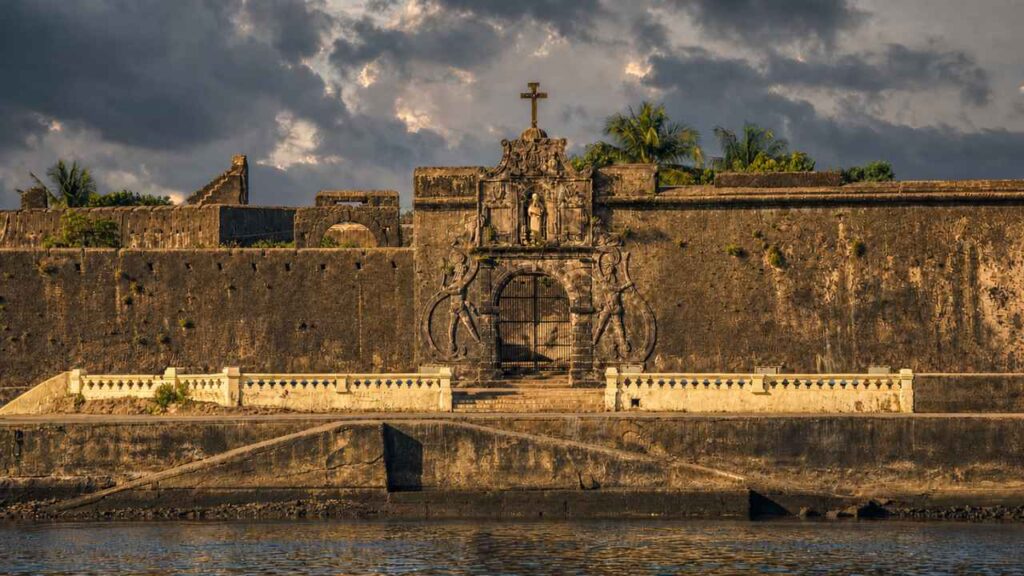
Quietly alongside the dock on the north bank of the Damanganga River stands Nani Daman Fort with its high stone walls and sculpted gateways echoing the calm hum of daily life through its ramparts. It doesn’t yell for attention like other larger forts, but its secret weapon is that river views, statues, and a cathedral are all squeezed into one compact location.
The Nani Daman Fort is modest from the outside and is dwarfed by the larger sibling across the river, Moti Daman Fort. But step inside, and you will discover exquisite gateways, statues of Gothic style, the Church of Our Lady of the Sea, and a tranquil riverbank that has its own voiceless story of Portuguese days in Daman.
Quick facts about Nani Daman Fort
Quick “at a glance” look at Nani Daman Fort before you walk in:
- Location: north bank of the river Damanganga, near the jetty
- Other name: Fort of St. Jerome
- Built by Portuguese as a military outpost and river-front fortification in 17th century
- Famous for: Grand entrance with statue of St Jerome, towering walls and bastions, Church of Our Lady of the Sea
- Size: About 12,250 square metres fortified area
- Hours: 8 AM-ish to 4-6 PM, usually free to enter
- Best time to visit: October-March
- Read more on official Daman Tourism Site
Nani Daman Fort in Daman and its Significance
Nani Daman Fort is located just adjacent to the Nani Daman jetty, and the main gate of the fort faces the river and the bridge connecting to Moti Daman. The fort is small, with high stone walls, three bastions, and two gates. The main gate is impossible to miss, with a massive monument of St. Jerome and two sculpted human figures on either side.
The Nani Daman Fort has historically been working in tandem with the Moti Daman Fort to protect the Damanganga creek and the old village. Moti Daman had the larger colonial town and more administrative buildings. Nani Daman was more of a strategic defensive outpost, overlooking the river and offering extra covering against assaults from the sea and land.
History of Nani Daman Fort
St Jerome’s portal & Portuguese control
In the 16th century, Daman fell into Portuguese rule after a series of wars and was eventually seized by Governor Constantino de Bragança. The Portuguese gradually reinforced the banks of the river and built a secondary fort on the northern bank called Nani Daman Fort or St. Jerome Fort.
St. Jerome Fort was mostly built in the early 17th century, with some sources saying construction started around 1615 and was finished by 1627. It was named after St. Jerome, a much revered priest in the Catholic Church. The front facade features a Portuguese carved cross, inscriptions, and the statue of St. Jerome at the main gate, which represents military and religious importance.
For hundreds of years, the Nani Daman Fort was a major military base, with artillery, bastions, and defenses overlooking the river. It also saw lesser-known occurrences, including the last public execution in the Portuguese empire, which is believed to have happened here just before capital punishment was abolished in Portuguese lands in 1870.
A lesser fort, albeit with a substantial presence
Nani Daman Fort is smaller than Moti Daman Fort but nevertheless impressive to behold. It includes towering walls, three bastions, and two doorways (one dramatic river-facing entrance and the other a secondary sea gate). Inside, a clutter of buildings—church, chapel, ex-prison, and residences—performed the spiritual and administrative functions of the colonial period.
What is left of the Nani Daman fort today
Riverside vistas, bastions and gateways
The first entrance you see coming up to Nani Daman Fort from the town side is one of the most attractive aspects of the fort. The main entrance is arched with a statue of St Jerome above and two carved human figures on either side of the arch. As you pass through the gateway, the river and the bridge are in view, and you see framed vistas of water and the opposite banks.
The fort had three bastions, often mentioned in the sources as São Jerónimo, São Paulo, and São Filipe, or similar names, that jutted out from the walls and served as points of advantage for defense and observation. From the bastions and wall-top walkways you can peer out over the Damanganga River, the jetty, and, across the water, the bigger Moti Daman Fort.
Another doorway faces in a different direction and is less elaborate but, nonetheless, of interest, with a circular roof access and openings where cannons may be positioned. The gates and bastions together lend shape and character to the Nani Daman Fort.
Our Lady of the Sea Church
Inside the fort, the main edifice is the Church of Our Lady of the Sea, a stunning example of Portuguese colonial church architecture. The church was erected on the site of an earlier chapel, which was constructed circa 1627. The façade is basic yet attractive, and the internal features represent the early Catholic presence in Daman.
The church still operates today and is under the Archdiocese of Goa, Daman & Diu. Worshipping in the church in Nani Daman Fort gives you a sense of continuity. The centuries have passed, but the edifice still functions as a place of worship, community, and peaceful reflection.
Smaller buildings and open spaces within and around the fort are now used as playgrounds or as public spaces, but they indicate how the fortified zone adapted itself to normal life while yet keeping its historic bones.
Nani Daman Fort: How to Reach
Air travel: The nearest airport is in Mumbai, which is about 180 miles distant and has daily flights from all parts of India. From Mumbai, you may reach Nani Daman Fort by road or rail and then through Daman town.
By Rail: Nearest railhead is Vapi, 14 km away from Daman. Vapi is on the Mumbai–Ahmedabad train line. From Vapi station, you can take a bus, auto or taxi to Nani Daman and then walk to Nani Daman Fort, which is very near to the jetty and the central section of town.
Daman is a short trip off NH8, which links Mumbai and Gujarat by road. On arrival at Daman, follow the signs to Nani Daman and the jetty. The fort’s tall stone walls and the gateway of St. Jerome’s are impossible to miss, being right by the riverside.
When to visit Nani Daman Fort
The best time to visit Nani Daman Fort is the cooler months of October to March when the sea wind and the river air make walking around the fort enjoyable. The light is softer for taking photographs, especially in the mornings and late afternoons.
Summer can be very hot and humid (particularly near the river), so think about shorter visits or early/late timing. Monsoon offers a distinct mood, with clouds and mist over the Damanganga, but watch out for wet stones and check local conditions.
What to see and do around Nani Daman Fort.
Inside and around Nani Daman Fort you can:
- Go through the main gate. Look at the statue of St. Jerome, the carved figures, the cross, and the inscriptions.
- Walk the bastions and wall-top pathways for views out over the river, scenes of the jetties, and a view of Moti Daman Fort across the water.
- Go to the Church of Our Lady of the Sea, and take a few quiet moments within this colonial church.
- Wander round the modest interior gardens and note how the fort has become part of local life—play places, informal routes, and the usual hustle and bustle.
You may easily combine Nani Daman Fort with:
- To experience the defense tale of both sides of the river, stroll across the bridge to Moti Daman Fort.
- Time on adjacent beaches like Devka and Jampore, or in cafes and booths along the river.
Tips to Visit Nani Daman Fort
For a comfortable visit to Nani Daman Fort:
- Make sure you wear comfortable shoes because you’ll be walking on stone and climbing little stairs to bastions or wall walkways.
- The fort area is tight, so bring drinks and basic sun protection.
- Plan for at least 45-90 minutes here with extra time to go down the riverfront and on to Moti Daman.
A little riverside fort with character
The Moti Daman Fort is big and sprawling, but the Nani Daman Fort is intimate and compact. It’s the details that make it charming. The statue of St Jerome at the entrance, the carved figures, the Church of Our Lady of the Sea, the bastions overlooking the river, and the way everyday Daman life flows around and through the old walls.
If you prefer forts that don’t require attention but reward a curious eye, Nani Daman Fort is a quiet stop you will remember. Save this post for your Daman trip, share it with someone who loves to explore secret historic nooks, and keep following the sequence of sea forts of India as we continue along the coast.