
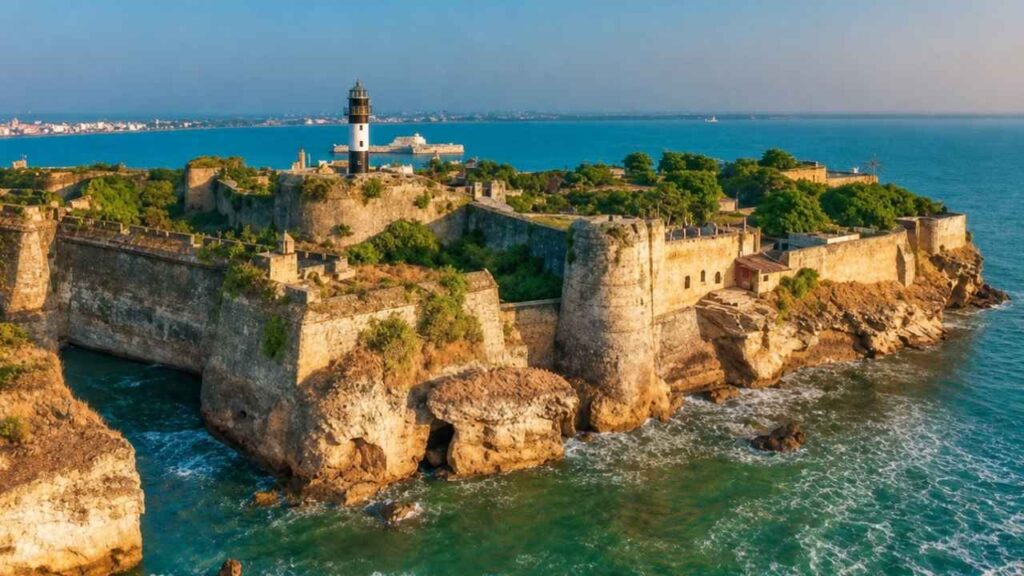
Diu Fort, on the edge of the Arabian Sea, feels like a giant stone’s memory waiting to be explored. Water on three sides, its walls, bastions, and churches silently contain the tales of sultans, Portuguese governors, ferocious wars, and Operation Vijay, India’s own.
If you are a fan of places where history and travel go hand in hand, Diu Fort offers you both: sea views and ruins, cannons and churches, calm alleyways and the echo of a dramatic past. It’s one of those forts where you don’t just “see” the place; you walk through layers of time.
Diu Fort – An Overview
The Diu Fort is a quick overview before you read the complete story.
- Location: Diu Island, Daman & Diu Union Territory
- Coast: Arabian Sea, west coast of India
- Built by Portuguese, fortified in 16th century
- Early ruler: Sultan of Gujarat (first fortifications 14th century)
- Famous for: Double moats, sea-facing walls, cannons, churches, participation in Operation Vijay
- Best time to visit: October-May.
- Nearest airport: Diu (Diu Fort is 5 kilometers away)
- Nearest railhead: Veraval (about 80 km).
- Best time to visit the fort: 2-3 hours for a leisurely visit
Where Diu Fort is and why it is important
Diu Fort is situated on Diu Island, off the Gujarat coast, in the Union Territory of Daman & Diu. The outside wall of the fort goes along the coastline and the Arabian Sea virtually caresses its stones. Built-in bastions allowed cannons to overlook the inner wall and a double moat protected the fort from attacks from the land .
The spot was not selected for its beauty alone. Diu Fort was located on a strategic sea route and was a key place to control maritime trade on the west coast. It was part of a bigger saga of spice routes, fabric, precious stones, and foreign countries striving to safeguard their interests in Indian ports.
History of Diu Fort
From the Sultan’s stronghold to Portuguese Praça de Diu
Diu Fort history The history of Diu Fort dates back to the 14th century when Sultan Shah Bahadur of Gujarat seized the island of Diu in 1330 AD and built fortifications to rule the place. The strategic position of Diú in the Arabian Sea was appreciated long before the Portuguese came.
Diu Fort was always under the watchful observation of the Portuguese. They needed a stronghold to safeguard their commerce and ships, and Diu was ideally placed. The chance arose when the Sultan of Gujarat asked for Portuguese support against an onslaught by the Mughal Emperor Humayun. In return for military support the Portuguese obtained a foothold at Diu and began expanding the fort.
Nuno da Cunha, the then governor of the Portuguese territories in India, restored and reinforced a number of edifices inside Diu Fort. That’s when it became Praça de Diu, the fortified Portuguese fortress that would soon suffer spectacular sieges from other powers.
Sieges, battles and staunch defenders
In 1538 the Turks besieged Diu Fort with a formidable fleet of six ships and about 20,000 troops. The Turkish and Portuguese garrison then fought a bitter struggle. The defenders of the fort were about to fall, but for reasons not quite known to this day, the Turks lifted the siege and turned back to the Red Sea. Of the 400 Portuguese troops in the fort only perhaps 40 survived.
The Sultan of Gujarat often attempted to capture Diu Fort, especially during the reign of Mahmud III in the middle of the 16th century. These attacks, however, did not succeed, and the Portuguese continued to hold on to the fort, tightening their grip over Goa, Daman and Diu. For centuries Diu Fort was a symbol of their presence on the Indian coast.
Operation Vijay and Liberation of Diu
Even after the independence of India in 1947, Goa, Daman, Diu, and Dadra and Nagar Haveli were still part of Estado da Índia under Portuguese authority. The Portuguese refused to negotiate, saying they were not colonies but part of metropolitan Portugal. Diplomatic attempts to bring these territories into India failed.
Activists started to stage minor protests and attacks, and tensions started to rise. India in 1961 had prepared a decisive military operation, Operation Vijay, with air, sea, and land strikes over Goa, Daman, and Diu. The operation took roughly 36 hours, and the Portuguese finally gave up. Diu and Diu Fort were finally liberated and merged with India on 19 December 1961. A memorial is erected to the 34 Indian troops who died in the conflict, opposite the Collectorate Office in Diu.
Standing on the walls of Diu Fort today and looking out at the sea, it is hard not to think of that chapter of history, the ships, the soldiers, and the final turning of the tide.
Learn more about Operation Vijay here.
Diu Fort as it stands today
Through gates, bastions and lighthouse you go
You go in through five big windows on the main gate of Diu Fort. Inside, on the left there is a temple and right ahead a big Portuguese bell with an inscription that still grabs notice. Scattered about the fort are antique cannons and iron shells, remnants of its more violent past.
The fort had three gates to enter and was protected by a double moat. A bridge is the primary road leading up to Diu Fort, across the old water defenses. At one end of the fort is a lighthouse, guiding ships nowadays and contributing to the stunning skyline of the ruins.
Churches, museum and old cottages
At its height, the territory of Diu Fort was greater, and three churches were included in the walled complex. They still give the town a strong heritage flavor today.
St. Paul’s Church is a fine example of Gothic architecture, complete with a fine patio, elegant exterior, and rich woodwork paneling.
St. Francis of Assisi Church was erected in 1593 on a hilltop and used to be just a church, but now it is a hospital. It is reached by climbing a long flight of stairs.
St. Thomas Church, with its elegant exterior and faded murals from the Portuguese era, has been converted into a museum housing local artifacts, stone sculptures, wood carvings and shadow clocks. An annual mass is conducted here on 1st November.
Passing through the Makata alleyways near the Zapata gate of Diu Fort, you can see the historic bungalows and havelis in the Gothic style, which were originally owned by the rich Portuguese and Indian traders. They lend an air of lived-in, old-world beauty to the region, as though the stories of trade may still be lurking behind their closed windows.
Diu Fort Outposts: Panikotha, Vanakabara and Nagoa
While you approach Diu Fort, you may spot a fort-like structure in the sea. That is Panikotha, a small fort erected in the sea to add an extra layer of protection to Praça de Diu. Inside there is not much left, but the walls stand firm, and you may get a close-up view on a ferry journey.
To assist Diu Fort, the Gujarat Sultans constructed two further coastal fortresses, Vanakabara and Nagoa. Vanakabara is in the western end of Diu Island. Nagoa is at the south-eastern end of Diu Island. Both had tiny harbors but never attained the importance of Diu, which remained the principal port and maritime center.
How To Get To Diu Fort
One of the best things about Diu Fort is that it is quite easy to reach, especially if you have planned a seaside vacation through Gujarat.
By Air: The nearest airport is Diu Airport, which is roughly 5 km away from Diu Fort. If you’re traveling from Maharashtra, there are regular flights connecting Diu with Mumbai, making it a convenient weekend or quick trip.
By Rail The nearest significant railhead is Veraval, about 80 km from Diu. From Ahmedabad and other cities in Gujarat, trains connect to Veraval. From there, you can take a cab, shared vehicle, or bus to Diu Fort and the town.
Diu Fort can be reached by vehicle by national and state routes. A usual route from Mumbai is to take NH8 up to Vadodara and then take a diversion via Bhavnagar and the coastal road towards Diu. The trip itself is picturesque and gives you an idea of how these coastal forts previously dotted the maritime map of western India.
Diu Fort Timings
The best time to see Diu Fort is between October and May. The weather is nicer in these months, and the walk along the ramparts is delightful in the sea air.
Monsoon months can be fantastic, but heavy rain, humidity, and strong waters may limit how much time you can comfortably spend visiting the open portions of Diu Fort. If you’re going to shoot the fort and the sea, winter and early summer mornings or late afternoons are good for soft light.
Things To Do In & Near Diu Fort
You may spend a few hours at Diu Fort if you walk carefully, stop for photos, and read the inscriptions. Outside the fort, the place is a blend of historical, sea, and small-town charm.
Take a walk through the bastions and fort walls, and enjoy the views of the Arabian Sea.
Visit the lighthouse and learn how navigation evolved throughout the years.
Visit St. Paul’s, St. Francis of Assisi, and St. Thomas Church, each with a distinct slice of Portuguese-era architecture and local adaptation.
Stroll the lanes of Makata to see historic bungalows and havelis, and experience the feel of a bygone trading town.
Take a ferry to Panikotha and have a close encounter with the marine outpost.
After exploring Diu Fort, spend time on the beaches of Diu and check out local temples, markets, and food. The fort provides the historic centerpiece for a leisurely day at the coast.
Best advice for visiting Diu Fort
To make the most of your visit to Diu Fort:
- Please wear appropriate walking shoes, as the fort includes uneven ground, steps, and open spaces.
- Water and sun protection, particularly if you are going in the warmer months.
- Plan to spend a minimum of two hours at the Diu Fort and some other time for the churches around it and Panikotha.
- If you enjoy reading, you may grab a few notes about the history of the fort so you can tie the architecture into the narrative as you stroll through.
- To capture better shots and escape the intense midday sun, go early or later in the afternoon.
Final thoughts: traveling through the history at Diu Fort
It is unique to be standing inside Diu Fort, looking out on the Arabian Sea. You know that this coastline was formerly held by the troops of the Sultan, that Portuguese cannons were ready on these bastions, that Turkish armies besieged it from the sea, and that Indian soldiers fought to liberate this island in Operation Vijay.
As you pass through the gates, past the bell, the antique cannons, the lighthouse, and the churches, Diu Fort stops being a mere tourist destination and becomes a lived story of India’s coastal past. It is one of those forts where if you calm down, listen, and allow the area to talk to you, you will be rewarded.
If this guide allowed you to explore Diu Fort from a new perspective, keep it for your future trip, share it with someone who likes history and travel, and stay tuned for the next fort in our Sea Forts of India series.