
My alarm went off at 4:15 AM on a Sunday.
I want to say I jumped out of bed, energized and purposeful. What actually happened was a brief internal negotiation between the person who had signed up for a Santala Devi Temple trek with 70 strangers at 5 AM and the person who was very comfortable under a blanket in Dehradun at 4:15 in the morning.
The first person won. Narrowly.
By 5:00 AM I was at Centrio Mall. By 5:30 we were in our vehicles heading toward Galjwadi. And about an hour and fifteen minutes after that, I was standing on a hilltop at 2,083 meters looking at the most uninterrupted stretch of green valley I have seen since moving to Dehradun—wondering why I don’t do this every weekend.
This post is about that Sunday. The trek, the jungle, the sweat, the story behind the temple, and a valley that made every steep step worth it.
The 5 AM Club — What It Actually Is
Before the trek itself a note on the 5 AM Club for those who haven’t heard of it.
It’s a community. A loose, warm, genuinely enthusiastic group of people in Dehradun who get together for early morning treks, hikes, and outdoor experiences. 5 AM is aspirational—as anyone who’s been will tell you, actual departure time is closer to 5:30. But nobody minds. The spirit of the thing is correct even if the clock isn’t.
We were seventy people that Sunday. Seventy. Gathered in a mall parking lot in the dark, cars pointing outward, strangers becoming familiar faces through the shared experience of also having set a 4 AM alarm on a day off.
I’ve done corporate off-sites that cost significant money and produced less genuine community energy than this parking lot at 5:15 AM.
There’s something about a shared early morning — a shared decision to choose something uncomfortable over something easy — that strips away the social performance and leaves people more themselves. By the time we reached the trailhead, people who had never met were walking together, talking easily, and sharing water bottles.
The Santala Devi Temple trek, this particular Sunday, was as much about this as it was about the destination.
The Drive to the Trailhead
7-8 km from Centrio Mall, along the Kimadi route, past the village of Galjwari.
On the left side of the road is a board. Santala Devi Temple. Arrow pointing downhill.
Most people drive straight past this. The standard approach to the temple comes from the other direction — a short, paved, fifteen-minute climb that is entirely manageable and perfectly fine. We weren’t taking that route.
We had chosen the Kimadi jungle trail. Longer. Steeper in places. Through actual forests with actual streams. About an hour and fifteen minutes of proper trekking versus fifteen minutes of paved road.
The reason we chose it is the reason most good decisions in travel are made: because the harder route usually gives you more. Not always. But usually enough to be worth attempting.
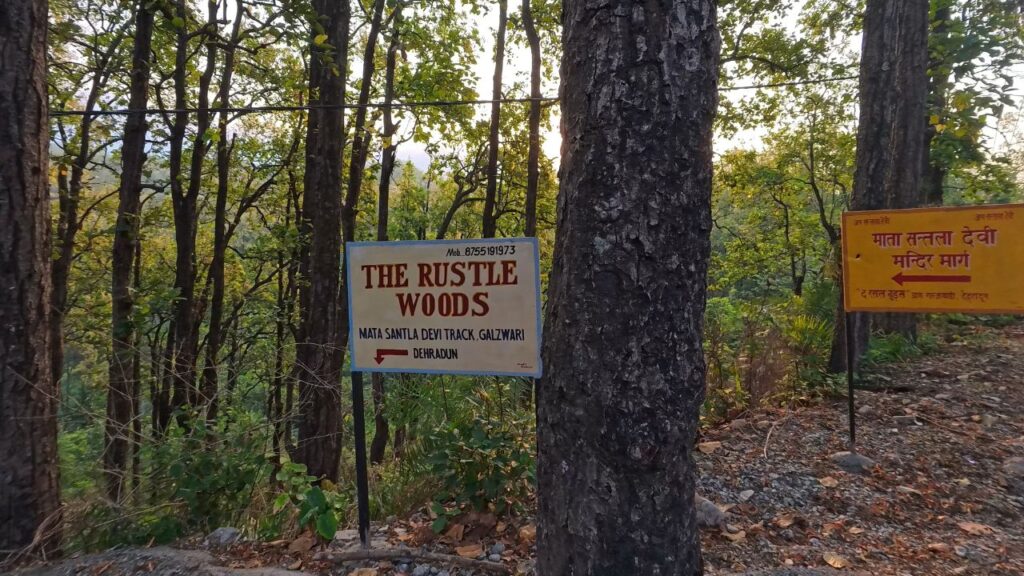
The Concrete Road and the First Ten Minutes
From the board, the path begins as a concrete road going steeply downhill. This section takes about ten minutes. There’s a resort you pass on the way—visible from the path, set back from it. You leave it behind, the concrete narrows, and then at some point—and it’s a specific, noticeable point—the constructed world ends.
And the jungle begins.
I’ve done enough outdoor trips to appreciate this moment for what it is. The shift from human-made to forest-made is not gradual. It’s a threshold. One step, and you’re on concrete with a resort behind you. Next step: you’re on the forest floor with trees on both sides, and the sounds have changed and the light has changed, and something in your chest settles slightly.
The Santala Devi Temple trek from the Kimadi side gives you this threshold early. Within fifteen minutes of leaving the vehicles, you’re in proper jungle.
Into the Jungle — The Streams and the Green
The first section of the jungle trail goes downhill. Gently, then more noticeably. The path is clear but not manicured—you’re walking on earth and root and occasional stone, not on a groomed surface.
What was immediately striking was how green everything was. We were there outside of monsoon season—not much rain had fallen recently—and yet the forest was fully alive. Lush. Dense. Multiple shades of green overlapping. The kind of scene that makes you wonder why you spend time looking at photographs of nature when actual nature is available at this distance from where you live.
There were water streams. Multiple, small, running across the path and alongside it. Not full monsoon flows—in the dry season these streams are gentle, manageable things—but enough water to hear, enough to feel the cool air around them, and enough to make the ground smell the way forest ground smells when moisture is present.
Crossing them was simple—stone to stone, or in some cases just stepping through the shallow water. With seventy people in single file doing the same thing, there was something comic and cheerful about it. Someone would find the driest route and point it out to the person behind them. Someone else would just splash through and receive mild judgment from the group.
Ten to fifteen minutes of this—shaded, green, gently downhill, streams appearing and crossing—and then the path reached a larger stream.
The Big Stream and the Point of No Return
The large stream at the bottom of the descent marks the transition of the Santala Devi Temple trek from the pleasant to the challenging.
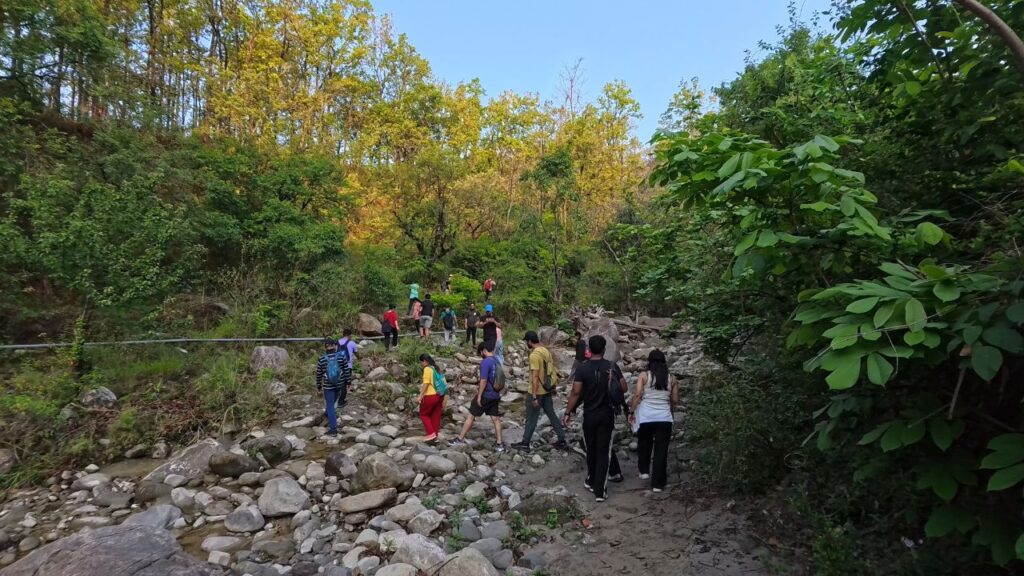
It was wide — wider than the earlier crossings — but the water level was low enough to cross without drama. In monsoon season this would be a different calculation entirely. That Sunday, we crossed without anyone getting more than their feet wet.
On the other side, the path goes up.
Not gradually up. Up.
The Climb — Everything the Jungle Route Promises
Forty minutes of uphill. Fairly steep throughout. Exposed to direct sun in stretches, with patches of shade that became progressively more appreciated as the climb continued.
I want to describe this accurately rather than either underselling the difficulty or making it sound like a survival exercise. It’s a proper climb. The kind where your heart rate settles into a zone it stays in for a while and your conversation becomes shorter and more functional—less “How did you get into trekking?” and more “How much further do you think?”
The sun at 6:30 AM was already working. Not the brutal midday sun of later in the morning, but present and direct and combined with the humidity of a dense forest—the kind of humidity that doesn’t blow away; it sits. Within fifteen minutes of starting the climb, everyone was sweating. Within thirty minutes, nobody was pretending they weren’t.
Seventy people spread across a jungle trail, climbing at their own pace, looking approximately the same combination of determined and tired — it was one of the more honest sights I’ve seen on any outdoor trip.
There were patches of shade on the way up. And I want to give those patches their proper credit, because in the context of that climb, two minutes under tree cover with cool air moving felt like a specific, genuine gift. People would reach a shaded section and slow almost involuntarily. Breathe differently. Then continue.
This is what the Kimadi route offers that the paved route doesn’t. Not just a longer walk — a physical experience that earns its ending.
The Valley — The Reason for All of It
Near the top, the gradient eases. The trees thin slightly. The path levels out.
And then you turn and look back.
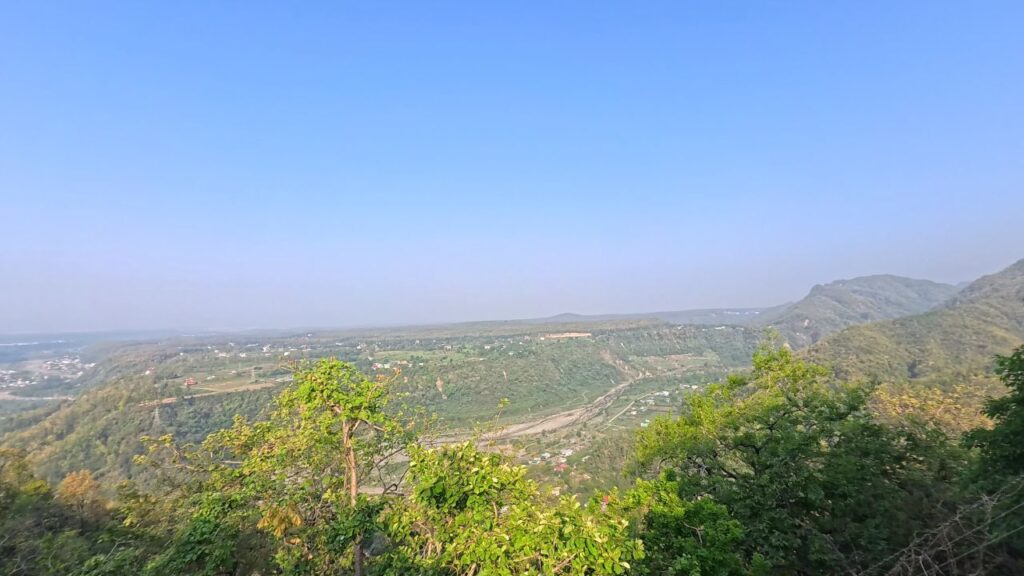
The valley below is fully, completely, uninterruptedly green. No brown patches. Not a single one. Every slope, every hillside, every piece of ground you can see from that vantage point is covered in forest. The sun was shining directly on it—not creating glare, but illuminating it from the side, the way morning light illuminates things, giving depth to the green rather than washing it out.
I stood there for a moment before doing anything else.
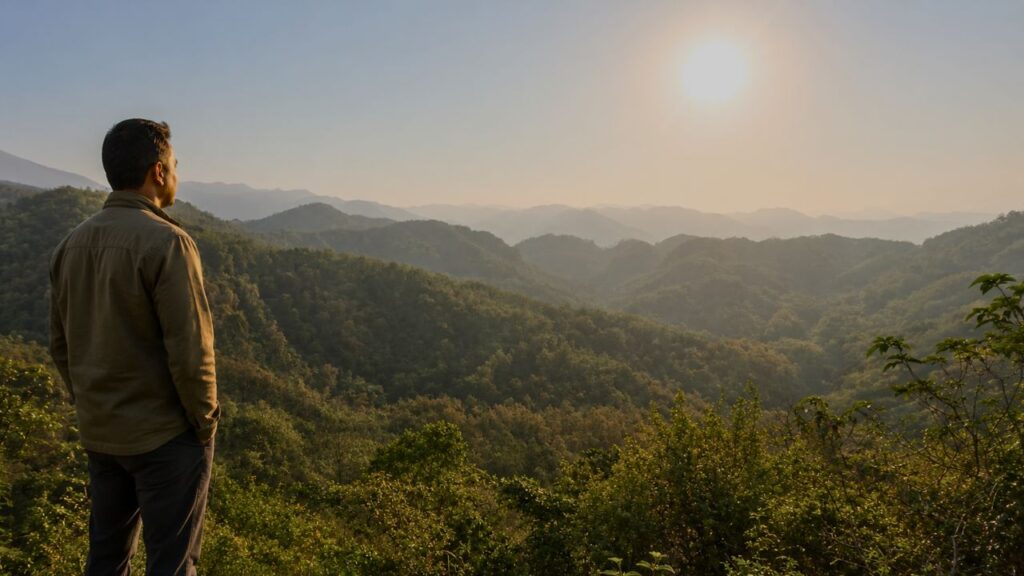
Seventy people arrived at that viewpoint in waves over about ten minutes, and every single person had the same reaction — they stopped talking, looked out, and went quiet for a beat. Then someone would say something. Or not say anything. Or take out a phone and immediately understand that the phone wasn’t going to capture it.
This is the payoff that the Santala Devi Temple trek from the Kimadi route offers. Not just a temple at the end. Not just religious significance. A valley earned by an hour of jungle walking that you cannot see from a car or from the paved route. A valley that exists specifically for the people willing to climb to it.
The sweat had been worth it at the twentieth minute of the climb—I had just not known it yet. Standing there, I knew it.
The Temple—And the Story Behind It
A flat stretch of path and then the temple complex. Stalls selling pooja items and snacks. The familiar sound and smell of a place of worship on a Sunday morning. Crowds.
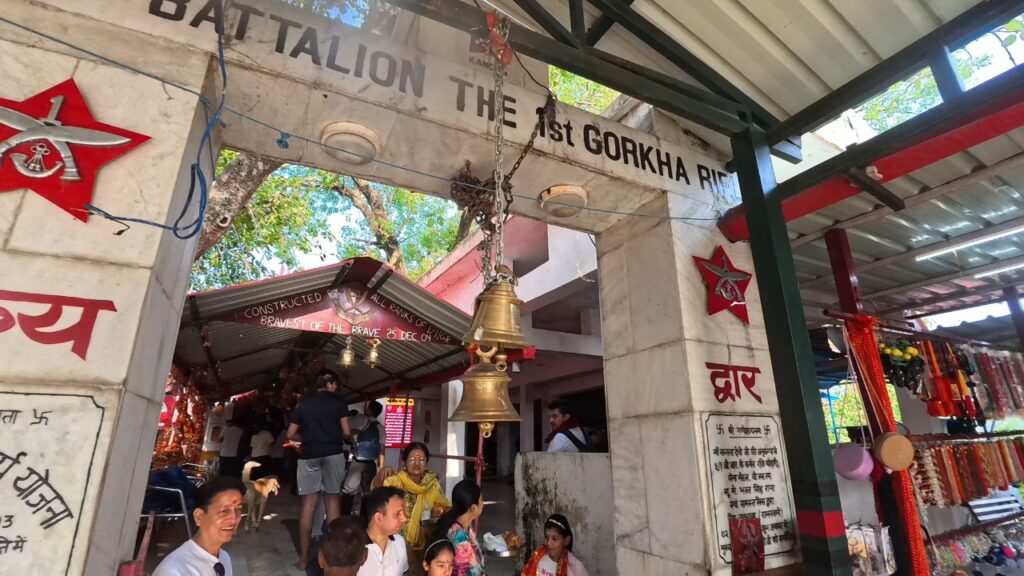
We’d come from the quiet of the jungle into the noise of a busy temple on a busy day. The contrast was sharp and not unpleasant—it’s the contrast that pilgrimage sites have always created, the movement from effort and solitude to gathering and devotion.
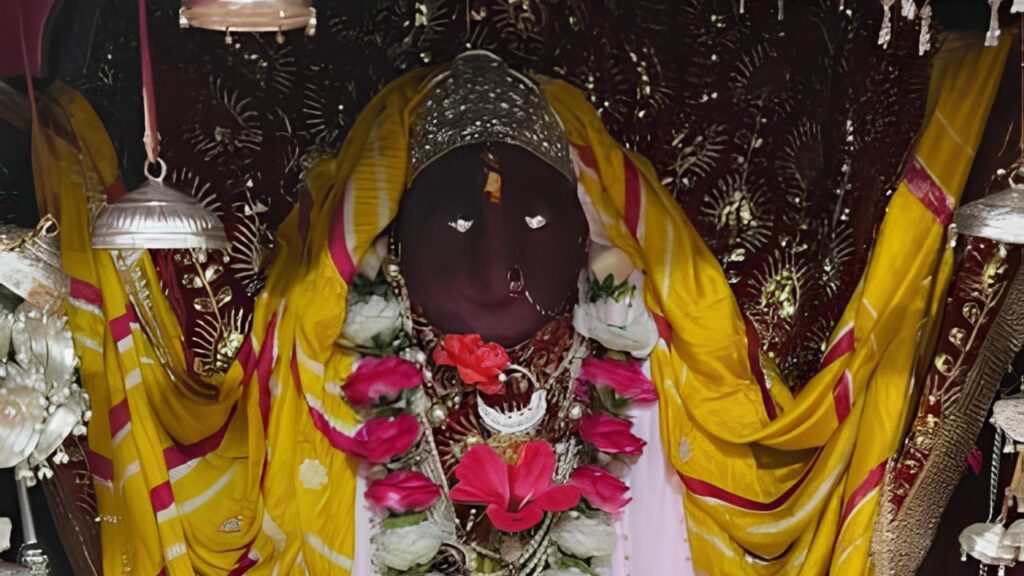
Before Darshan—the story. Because the Santala Devi Temple without its legend is a building on a hilltop. With it, it’s something considerably more significant.
Santala Devi was the daughter of the king of Nepal. When Mughal emperor Aurangzeb decided he wanted to marry her, her family fled—not to safety in the conventional sense, but to these hills. To what is now the Dehradun area. Santala and her brother Santaur Singh lived here, in a fort called Santore Garh in what is now known as Panjabiwala.
Aurangzeb found out. His army came.
Santala and her brother fought. They fought until the point where fighting any further was impossible—where the arithmetic of the battle was clear and unfavorable. And then they made a different choice.
They put down their weapons. And they prayed to Goddess Durga.
A light appeared—suddenly, totally. Both siblings were transformed into stone. The Mughal soldiers were blinded by it.
The fort of Santore Garh became the Santala Devi Temple. The stone into which Santala and her brother transformed became the idol that devotees visit today. And because this happened on a Saturday, Saturdays carry special significance here—the temple sees its largest crowds on Saturdays throughout the year.
Standing in front of those idols—having just walked through the jungle those two people had looked out over from this hilltop—the story feels less like mythology and more like the specific history of a specific place. Which is, I think, exactly what it is.
Darshan, the Quieter Side and the Viewpoint
The darshan was crowded in the way that popular Sunday temples always are. Queue, patience, a few moments in front of the deity, and the particular quality of attention that comes from having worked to get somewhere before you stand in front of something sacred.
Behind the main temple is a different atmosphere. Fewer people. Quieter. The kind of space that temple complexes sometimes have at their edges, away from the main flow of devotees, where you can stand without being moved along.
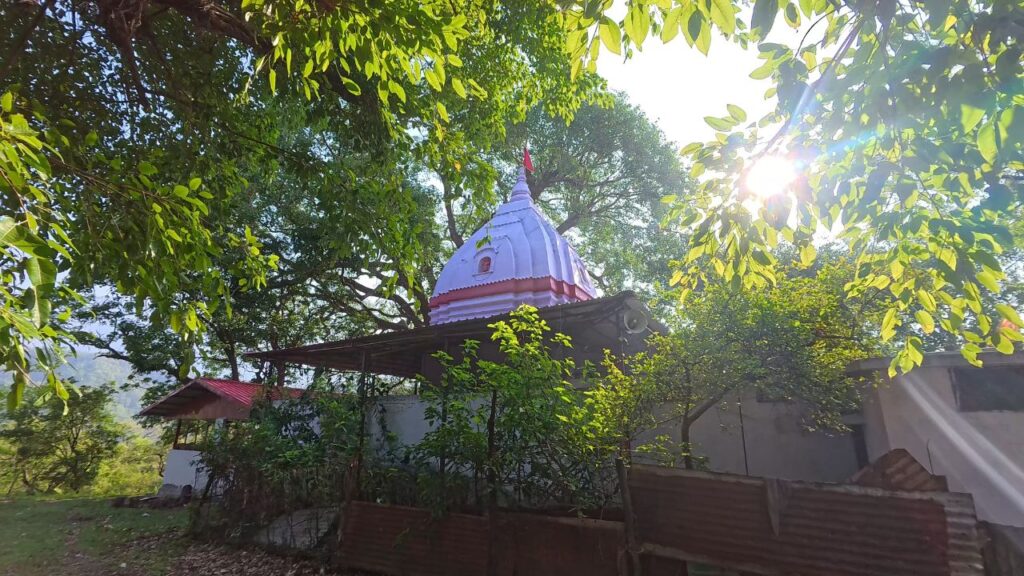
And beyond that, a viewpoint.
Looking out from the viewpoint, the River Nun was visible below. The valley we had climbed through was now below us from a different angle. The surrounding hills. The specific geography of this part of Dehradun—the ridgelines, the tree cover, the morning sky—all of it laid out from 2,083 meters.
We spent time here. Not structured, scheduled time — just the unplanned kind where you stay longer than you intended because leaving feels like the wrong thing to do.
The Descent — Easy Until It Isn’t
The return route was the same path. And for most of it, coming down was exactly as easy as climbing had been hard. The forty-minute uphill became a comfortable downhill. The stream crossing came and went. The jungle section was still green, still cool in the shade, still making the sounds it had made on the way up.
And then the final stretch. The concrete road from the resort back up to where the vehicles were parked. Steep. In direct sun. At 9 AM, which is a different sun from 6:30 AM.
If the jungle climb was the honest difficulty of the Santala Devi Temple trek, this final concrete section in the late morning sun was the joke at the end of the story. Everything else had been manageable — jungle shade, forest streams, the earned rhythm of a proper uphill. This final stretch was just sun and concrete and the particular suffering of being almost finished but not quite.
We made it. Everyone made it. I drank an entire bottle of water when I reached the car. Possibly faster than I have ever drunk anything.
A Few Things Worth Knowing Before You Go
The route choice: The Kimadi jungle route and the standard paved route both end at the same temple. The standard route is shorter and completely accessible. The Kimadi route is the one worth taking if you have the time, the footwear, and any interest in what the jungle between the trailhead and the summit actually looks like. Do not attempt the Kimadi route in flip-flops.
Start time: We left at 5:30 AM and reached the summit around 7 AM. The sun was already present and working by the time we were climbing. I would not start this trek after 7 AM in the warmer months. The final concrete section at 9 AM was the hardest part of the day, and it was hard specifically because of the sun. Start early.
Water: Carry more than you think you need. The streams on the route are not drinking sources. There are stalls at the temple selling water and snacks, but you want to reach the temple with water still in your bottle, not arrive dehydrated and immediately spend twenty minutes looking for a stall.
The big stream crossing: In the dry season—October to June, outside the monsoon—the stream is straightforward to cross. In or after monsoon, check current conditions locally before attempting this route. Water levels change significantly.
Temple timings: 7 AM to 12 PM, then 2 PM to 6 PM. Saturdays draw the largest crowds throughout the year. Sundays are busy too — we experienced this firsthand. If you want quieter darshan, a weekday morning is your best option.
The 5 AM Club: If you’re a Dehradun resident looking for an early-morning trek community, search for the 5 AM Club locally. The group organizes regular treks and hikes throughout the year, and the collective energy of doing something like this with seventy people makes a meaningful difference to the experience.
What Sunday Morning Actually Means
I drove home at about 10 AM. Fed. Watered. Significantly in need of a shower.
And I kept thinking about the valley.
Not the temple, which was beautiful and full of meaning. Not the legend, which deserves to be more widely known. Not the jungle or the streams or the stream crossing.
The valley. That specific moment of turning around at the top of the climb and seeing the whole uninterrupted green sweep of it in morning light.
That valley exists every day. It was there last Sunday and the Sunday before and every morning of the week. Anyone willing to drive 7-8 km from Dehradun and walk uphill for an hour in the jungle can stand in front of it.
Most people take the paved road. Fifteen minutes. Temple, darshan, back in the car.
Nothing wrong with that. But they don’t see the valley from the climb. They don’t earn it.
And I think the earned version—sweaty, slightly breathless, legs aware of what they’ve just done—is the version that stays with you.