
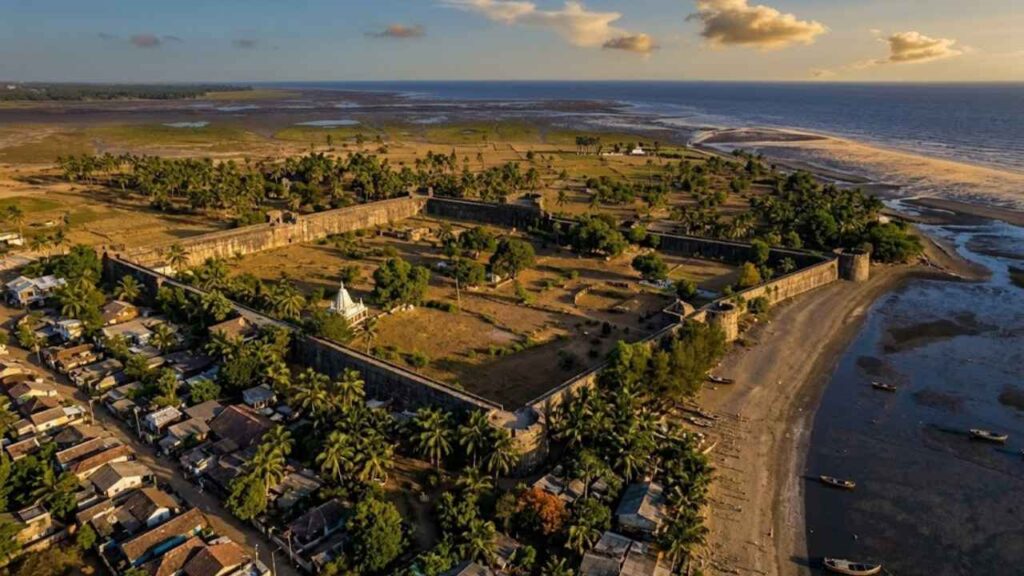
Arnala Fort is located on a small island off the coast near Virar, where the Vaitarna River meets the Arabian Sea. It looks like a little stone fortress rising out of the water, with waves on most sides and connected to the mainland by a narrow causeway and a short boat ride.
The fort is small in size but big in history. Over the centuries, it has been held by the Gujarat Sultanate, the Portuguese, the Marathas, and the British. This is also called Jaldurg and Janjire Arnala, both of which terms are indicative of its nature as a sea fort guarding a strategic river mouth.
What’s remarkable about Arnala is not just its location but the sequence of conflicts that formed it. It was first a coastal outpost under a local chieftain, then a Portuguese bastion, then a Maratha stronghold after the Battle of Vasai, and finally a British position during the colonial period. Through all these changes, it remained a key point of control over the Vaitarna and the coastal route north of Mumbai.
Arnala Fort at a glance
Where is Arnala Fort located?
Arnala Fort stands on an island off Arnala Beach near Virar in Palghar district, Maharashtra, at the mouth of the Vaitarna River, where it meets the Arabian Sea.
Who built Arnala Fort?
The site was first fortified under Sultan Mahmud Begda of Gujarat in 1516. The Portuguese took control in 1530 and built a Martello tower and other defenses. Later the Marathas rebuilt and enlarged the fort and named it Janjire Arnala. What is Arnala Fort famous for? The Arnala Fort is famous for its island location, 14 bastions, huge stone walls, and a unique Portuguese Martello tower. It is also called Jaldurg or Janjire Arnala and is one of the well-preserved coastal forts near Mumbai.
How do you reach Arnala Fort?
The nearest railroad station is Virar in the Western Line. From Virar, take a bus, auto-rickshaw, or taxi to Arnala village and Arnala Beach. From the shore, a short boat ride takes you to the island fort.
What can you see at Arnala Fort today?
Visitors can see the fort’s massive stone walls, 14 bastions (some damaged, some intact), gateways, the Martello tower, and panoramic views of the Arabian Sea and the Vaitarna River. The interior is largely open, with ruined structures and clear traces of its military past.
A small island at the mouth of the Vaitarna
Arnala Fort occupies a small island at the mouth of the Vaitarna River, just off Arnala Beach near Virar. The island is separated from the mainland by a narrow channel, which is crossed by boat and, in parts, by a low causeway that is visible at low tide.
This location is strategic. The fort commands the river mouth, the coastal shipping route, and the approaches from the sea. From its walls, you can see the coastline’s curve, the Arabian Sea’s expanse, and the Vaitarna’s inland stretch.
The island setting is what makes Arnala so unique. It feels more like a maritime fortress than a hill fort, with water on most sides and a clear line of sight over the surrounding sea and river.
From the Gujarat Sultanate to Portuguese control
The history of Arnala begins in the early 16th century. In 1516, a local chieftain under Sultan Mahmud Begda of Gujarat established a presence on the island. This first stage set the stage for a fortified outpost at the mouth of the Vaitarna.
The Portuguese captured the island in 1530 and began to alter it. They constructed a stout, round Martello tower, a type of coastal artillery tower designed to resist cannon fire and control nearby waters. This tower remains one of the most recognizable features of the fort today.
Under Portuguese rule, Arnala became part of the broader Vasai (Bassein) coastal defense system. It helped protect Portuguese interests along the north Konkan coast, monitor maritime traffic, and support larger centers like Vasai Fort.
Maratha conquest and the name Janjire Arnala
The Marathas captured Arnala in 1737, during the campaign led by Chimaji Appa that targeted Portuguese possessions along the coast. The fall of Arnala came in the context of the larger struggle for Vasai, which the Marathas would capture in 1739 after a prolonged siege.
After taking the fort, the Marathas rebuilt and strengthened it. They named it Janjire Arnala, stressing its identity as a sea fort. The present structure with massive stone walls and bastions and gateways built to withstand both naval and land attacks is largely a reflection of this Maratha phase.
General Shankarbuwa Shinde is often credited with playing a pivotal role in the Maratha operations against the Portuguese in this region, including the actions that led to the capture of Arnala and the weakening of Portuguese coastal control.
Fourteen bastions and a Martello tower
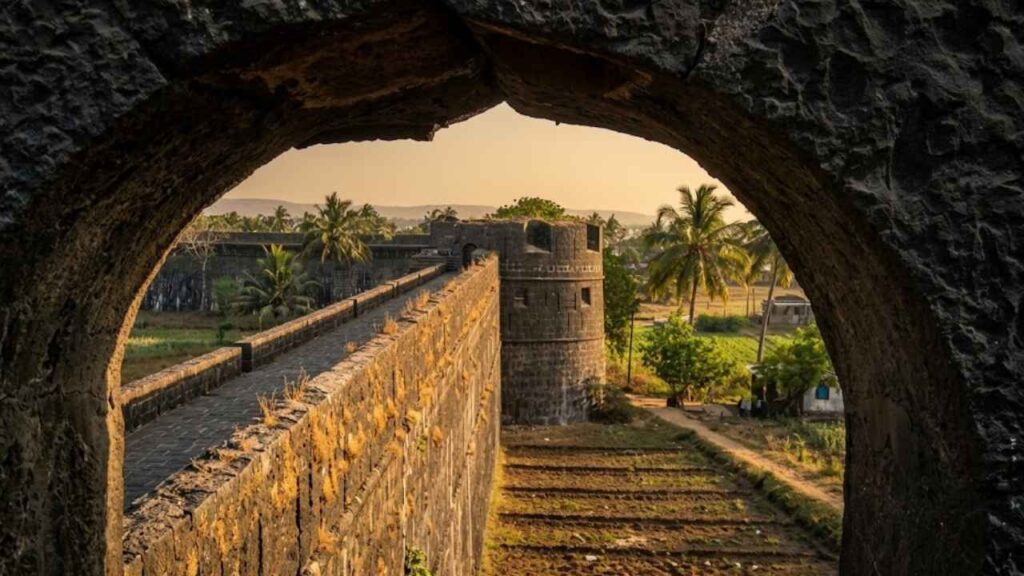
Arnala Fort is described as having 14 bastions along its ramparts. Some of these bastions have suffered damage, but several remain firm and strong, providing a clear sense of the fort’s original defensive layout.
The bastions allowed guns to fire in multiple directions, covering the sea approaches, the river mouth, and the landward side. Their placement implies that they are designed to resist attacks by sea-borne and land forces.
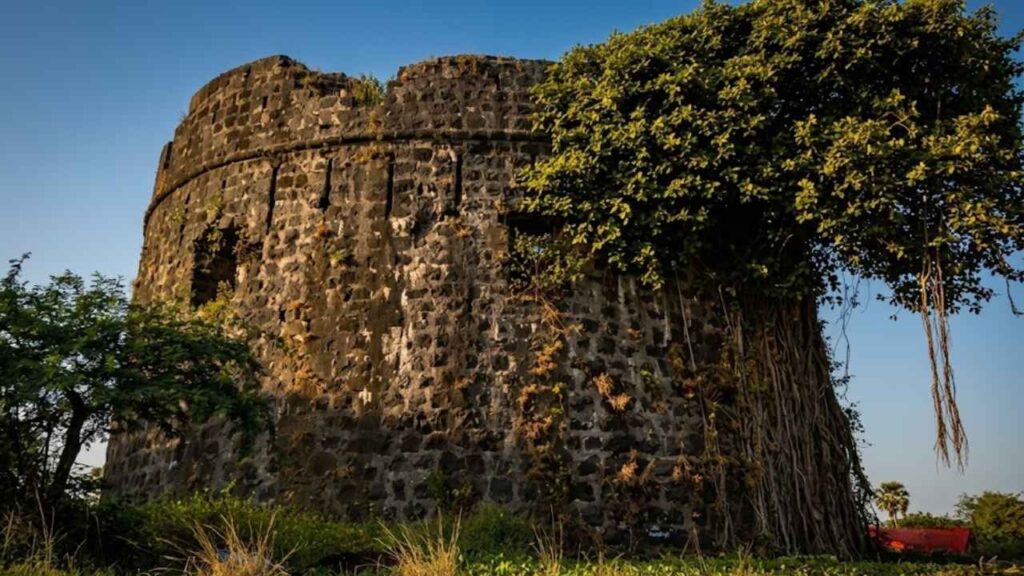
Another characteristic of the military architecture of the fort is the Portuguese Martello tower. This round, crenelated stone tower was constructed to house artillery and provide a protected firing position. It stands as a visible reminder of the Portuguese phase, even as the larger fort reflects Maratha reconstruction.
Together, the bastions and the Martello tower make Arnala one of the more architecturally striking coastal forts near Mumbai.
The fort of Agashi
The fort’s story is also connected to the nearby Agashi Fort, a mainland position that once formed part of the wider defense network around Vasai and Arnala.
Agashi stood near the historic settlement of Agashi, which developed as a Portuguese military and shipbuilding center because of its proximity to the coast and its access to timber.
Although little of the old fort is visible today, historical references suggest that Agashi remained strategically important even after Arnala came under Maratha control. In 1781, during the First Anglo-Maratha War, British forces reportedly prepared to bombard Arnala from the Agashi side. The episode shows how the island fort and mainland positions worked together to control movement around the Vaitarna coast.
British control and later history
After the Maratha period, Arnala Fort eventually came under British control. The British captured several forts in the region, including Arnala, as part of their wider strategy to control the Konkan coast during the First Anglo-Maratha War.
Later, the Treaty of Salabai restored the Arnala and Vasai forts to the Marathas. But the control was again changed by subsequent treaties, including the Treaty of Poona. These changes reflect how the wider struggle for dominance over the north Konkan coastline unfolded in the late 18th and early 19th centuries.
By the time the British had established their power, Arnala’s military importance had diminished. Like many coastal forts, it gradually deteriorated, its structures exposed to the wind, rain, and salt air.
Today, what remains of Arnala Fort?
The fort of Arnala is in ruins but still imposing. The massive stone walls and gateways remain largely intact, and many of the 14 bastions can still be identified, even if some are damaged.
Visitors today can see:
- The fort’s massive stone walls and main gateways.
- The 14 bastions along the ramparts, some firm, some partially damaged.
- The Portuguese Martello tower, a round, crenellated stone structure.
- Open courtyards and ruined interior structures.
- Cannon mounts and gun openings along the bastions.
- Panoramic views of the Arabian Sea and the Vaitarna River.
- The narrow channel between the island and the mainland, crossed by boat.
The fort is not fully restored, but its key features are still legible. Walking along the ramparts, you can trace the outline of the bastions, look out over the sea, and imagine the fort in its active military phase.
Visiting Arnala Fort: boat ride and island experience
A visit to Arnala Fort typically begins at Virar railway station on the Western Line. From Virar, you can take a bus, auto-rickshaw, or taxi to Arnala village and Arnala Beach, about 10 kilometers away.
At the shore, local boatmen operate small boats to the island fort. The ride is short but essential, as the fort sits on an island separated from the mainland by a narrow channel. At low tide, parts of a causeway may be visible, but the boat remains the standard means of access.
The boat ride adds to the experience. As you approach the fort from the water, its walls rise directly from the sea, giving a clear sense of its maritime character. Once you reach the island, head to the main gateway and explore the ramparts and interior.
Best time to visit Arnala Fort:
The best time to visit Arnala Fort is from October to March, when the weather is pleasant enough for walks, boat rides and exploring the ramparts.
During this time, early morning and late afternoon are best. The light is better for photography, the heat is milder, and the views over the sea and river are clearer.
Avoid visiting during the peak monsoon, when the sea can be rough, the rocks slippery, and boat operations unreliable. The fort can be visited in the post-monsoon months, but check local conditions and boat availability before planning the trip.
How to reach Arnala Fort
By rail: The nearest railway station is Virar on the Western Line of Mumbai’s suburban network. From Virar, the fort is about 10 kilometers away.
By road: From Virar, take a state transport bus, shared auto-rickshaw, taxi, or private vehicle towards Arnala village and Arnala Beach. The road journey takes roughly 20–30 minutes, depending on traffic.
From Arnala Beach to the fort: At Arnala Beach, ask locally for boatmen who take visitors to Arnala Fort. The boat ride to the island is short. Coordinate your return trip with the boatman to ensure you are not stranded on the island as evening approaches.
What to see near Arnala Fort
Arnala Fort is best visited as part of a wider north Konkan coastal circuit.
- Arnala Beach: The mainland beach that leads to the fort.
- Vasai Fort (Bassein): A larger, historically significant Portuguese-Maratha fort inland from the coast.
- Kelve Fort: A small, overgrown Portuguese ruin near Kelva Beach.
- Alibaug Fort (Kelva Pankot): A tiny tidal outpost at the mouth of Danda Creek.
- Mahim Fort: A small creekside fort in the Kelve-Mahim coastal network.
- Shirgaon Fort: A better-preserved coastal watchtower farther north.
- Tarapur Fort: A larger Portuguese fort with a stronger documented history.
- Virar: The nearest transport base for exploring this stretch of coast.
Practical tips for visiting Arnala Fort
- Start from Virar station and check local transport options to Arnala Beach.
- Negotiate boat fare and return timing with the boatman before departure.
- Wear proper footwear for boat rides, rocky paths, and uneven fort surfaces.
- Bring water to drink and sun protection, especially in the afternoon.
- Come in the daytime, and don’t make late evening trips to the island.
- Be careful on the ramparts, especially where the bastions are broken and the drop is steep.
- Never climb on the walls or enter dangerous areas of the fort.
- Respect local fishermen, boat operators, and residents. Please keep the beach, boat area, and fort nice.
- Understand that this is a protected but largely unrestored heritage site, not a fully managed tourist monument.
Is Arnala Fort worth a visit?
Arnala Fort is a good visit for lovers of island forts, maritime history, and well-defined coastal strongholds.
Not as big as some of the hill forts of Maharashtra, but its island setting, 14 bastions, and Martello tower give it a unique flavor. The boat ride adds an element of adventure, and the views from the ramparts over the Arabian Sea and the Vaitarna River are rewarding.
The history of the fort, from the Gujarat Sultanate to the Portuguese, the Marathas, and the British, affords a compact but rich introduction to the coastal struggles of the north Konkan region.
Final thoughts: A little island with a big history
Arnala Fort is a reminder that size does not always determine historical importance.
Centuries of war and change have washed over this little island fort. It was originally a Gujarat Sultanate outpost that became a Portuguese bastion with the Martello tower, then was rebuilt by Marathas as Janjire Arnala and later passed into British hands. Through all these phases, it remained a key point of control over the Vaitarna River and the coastal route.
Today, its walls and bastions still stand, even if partially ruined. The Martello tower remains a striking feature. The sea still washes against the island, and the river still flows into the ocean under the fort’s watch.
Visit Arnala with an eye for detail. Walk the ramparts, count the bastions, study the Martello tower, and look out over the water. In that small space, you can trace a large story of war, trade, and power along the Maharashtra coast.
Save this post for your next north Konkan trip, share it with someone who loves island forts, and follow the Sea Forts of India series as we continue along the coast.